- Home
- Ankle and Foot
- Overpronation
- Calcaneal Stance Angle
Calcaneal Stance Angle
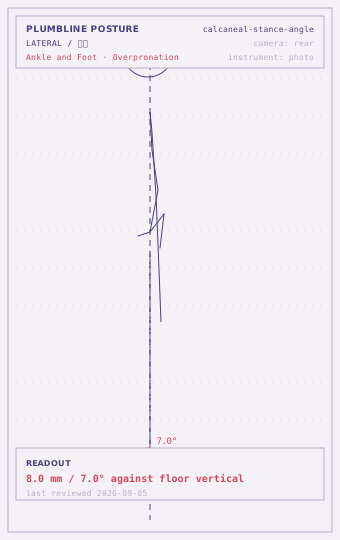
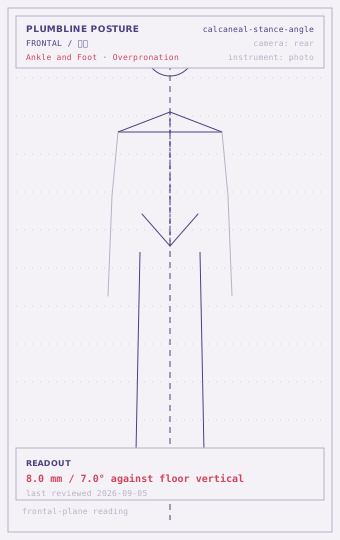
A photograph of the heels from directly behind. The angle between the Achilles line and the heel line is the clearest single number for how far the foot rolls in under weight.
- Gear
- A phone at floor level, a bare heel, and a marked standing spot.
- Stance
- Stand with the feet hip-width and the weight even, heels bare, in the usual turnout. Film from directly behind at floor level.
- Duration
- 120 s
- Camera angle
- lateral, lens level with the landmark
- Position
- Photograph the heels from behind, then draw the line of the Achilles tendon and the line of the heel. The angle where they meet is the reading.
Bone landmarks
-
Calcaneus — coordinate id
calcaneus -
Lateral malleolus — coordinate id
lateral-malleolus -
Right calcaneus — coordinate id
heel-r
Within range
0-5 °Criterion: The heel is within 5 degrees of vertical from behind, and the Achilles line runs straight down into the heel without a curve.
The heel is landing and standing close to vertical. Nothing here needs changing.
Borderline
6-10 °Criterion: Six to ten degrees of inward roll, or a clear curve in the Achilles line, or an angle that is visibly different between the two feet.
The heel is rolling inward, which the arch pays for. Read it alongside the navicular drop, since the two measure the same event from different directions.
Deviated
over 10 °Criterion: More than 10 degrees of inward roll, or the malleolus on the inner side prominent enough to touch the floor line in the photo, or pain along the inner ankle.
A heel rolled this far changes where the ankle joint is loaded. Have the ankle examined before treating it as a shoe-choice problem.
| Tier | What to do |
|---|---|
| Low | Reading sits in the within-range band and is symmetric side to side: re-measure every 8–12 weeks and record which way the number is moving. |
| Moderate | Reading sits in the borderline band, or the two sides differ clearly: re-measure every 4–6 weeks and log the daily trigger (hours seated, one-sided load). Change the situation before adding anything to the routine. |
| High | Reading sits in the deviated band, or several screens at the same station all read deviated: get a clinician to rule out a structural or neural cause before continuing to self-screen. |
| Referral threshold | A heel that rolls inward with pain at the ankle, or with a history of repeated sprains, should be assessed rather than shown a shoe. |
Commonly co-occurring
How to read this
Behind the foot, at floor level
From the front, a pronating foot looks like a dropped arch. From behind, it looks like a heel that is not vertical, with an Achilles tendon that curves as it runs down. The second view is more useful, because the angle it produces can be measured and compared.
This is one of the few screens on the site where a photograph and two straight lines produce a genuinely useful clinical-style number without any equipment.
Procedure
Stand on a marked spot, feet hip-width, weight even, bare heels, in the usual turnout. Put a phone on the floor directly behind, at floor level, and photograph both heels.
On the photograph, draw a line up the middle of the back of each heel and a line up the Achilles tendon where it meets the heel. Measure the angle where the lines meet, for each foot separately.
Reading it
Under 5 degrees, with a straight Achilles line, is the reference. Six to ten degrees, or a clear curve in the tendon, or a visible difference between the feet, means the heel is rolling inward under weight.
Over 10 degrees, or an inner ankle bone that looks like it is approaching the floor in the photograph, or pain along the inner ankle, moves this out of the posture category and into the clinical one.
Comparing sides and sessions
The most valuable use of this measurement is the pair: left against right on the same photograph, and this month’s photograph against the one taken three months ago. Both comparisons need the same standing spot, the same camera height and the same foot position, which is why the marked spot and the floor-level camera matter more than they look like they do.
Questions
Camera at floor level — why so low?
Because photographing a heel from above foreshortens it and makes the angle read smaller than it is. At floor level the two lines are close to their true lengths and the angle can be compared between sessions.
What is the heel line?
The vertical axis of the back of the heel, drawn up from the middle of the heel pad. The Achilles line is drawn up from where the tendon meets the heel. The angle between them is the reading.
Which foot should I measure?
Both, always. The difference between the sides is often more informative than either angle, and a single-foot measurement gives you nothing to compare it against except a threshold.
Disclaimer
This page is informational only. It is not a medical diagnosis and it is not treatment or rehabilitation advice. Run every self-screen inside a pain-free range; stop and see a clinician for pain, numbness, weakness, night pain, or anything that started after an injury. The readout criteria are drawn from healthy-adult norms — prior injury, surgery and individual variation all shift the numbers.
lastReviewed 2026-09-05 · record calcaneal-stance-angle · published 2026-09-11