- Home
- Knee
- Knee Hyperextension
- Heel Raise Lock Check
Heel Raise Lock Check
Rise onto the balls of the feet and watch what the knee does at the top. The same joint that rests past neutral while standing often locks harder the moment the calf works.
- Gear
- A wall for one fingertip, and a bare foot on a firm floor.
- Stance
- Stand facing the wall with one fingertip on it, feet hip-width, weight even. The fingertip is for balance only and must not take weight.
- Duration
- 60 s
- Camera angle
- lateral, lens level with the landmark
- Position
- Rise onto the balls of the feet, hold at the top for two seconds, then come down slowly. Note whether the knee stays at neutral at the top or pushes past it.
Bone landmarks
-
Lateral knee line — coordinate id
knee-lateral -
Lateral malleolus — coordinate id
lateral-malleolus -
Calcaneus — coordinate id
calcaneus
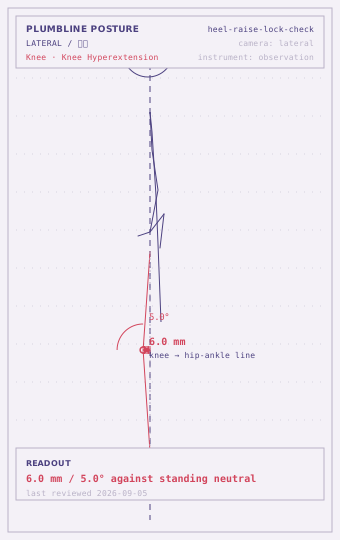
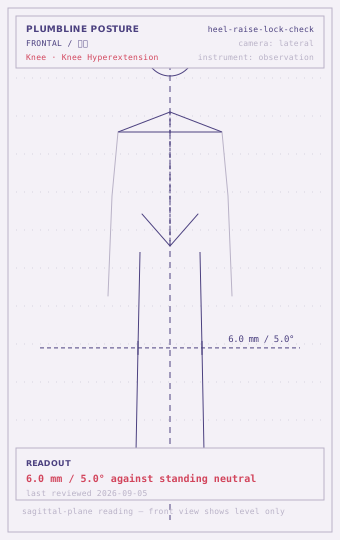
Within range
3 gradeCriterion: The knee stays at neutral at the top of the heel raise, the heel comes straight up, and the descent is controlled over two seconds.
The joint is controlled under load at the end of its range. This is the reference the other knee screens are read against.
Borderline
2 gradeCriterion: The knee pushes past neutral at the top, or the heel rolls outward, or the descent is dropped rather than lowered.
The end of range is not being controlled when the calf is working. This is the pattern that turns an end-of-range position into a repeated load.
Deviated
0-1 gradeCriterion: The knee cannot be held at neutral at the top at all, or the heel raise cannot be completed, or the movement produces pain.
Pain or an incomplete heel raise is a strength and tendon question rather than a posture one. Have it looked at before adding load.
| Tier | What to do |
|---|---|
| Low | Reading sits in the within-range band and is symmetric side to side: re-measure every 8–12 weeks and record which way the number is moving. |
| Moderate | Reading sits in the borderline band, or the two sides differ clearly: re-measure every 4–6 weeks and log the daily trigger (hours seated, one-sided load). Change the situation before adding anything to the routine. |
| High | Reading sits in the deviated band, or several screens at the same station all read deviated: get a clinician to rule out a structural or neural cause before continuing to self-screen. |
| Referral threshold | Pain at the back of the knee or in the calf during a heel raise, or a heel raise that cannot be completed, should be assessed. |
Commonly co-occurring
How to read this
Under load, at the end of range
The side photo screen reads the knee at rest. This one reads the same joint with the calf working, which is where an end-of-range position stops being a resting place and starts being a repeated stress.
The two readings do not always agree. A person can rest with the knee locked and control it perfectly the moment they move, and the reverse also happens: a knee that looks acceptable standing can push past neutral every time the calf contracts, dozens of times an hour, without the person noticing.
Procedure
Stand facing a wall with one fingertip resting on it for balance, feet hip-width, weight even. Rise onto the balls of the feet.
Hold the top for two seconds. Watch the knee: does it stay at neutral, or does it push backward past it as the calf contracts? Then lower over a slow count of two and note whether the descent is controlled or dropped.
Do three repetitions on each side and record what you saw, not what you intended.
Reading it
A knee that stays at neutral, a heel that comes straight up, and a controlled descent is the reference. A knee that pushes back at the top, a heel that rolls outward, or a dropped descent are all the same finding from different angles: the end of range is not being controlled when the leg is working.
A heel raise that cannot be completed, or one that hurts at the back of the knee or in the calf, leaves posture behind. Have it examined before loading it further.
What the check is really for
The point is not to eliminate the extra range — most people cannot, and chasing that is how a harmless position becomes an injury. The point is to know whether the position is controlled, because a controlled end-of-range position is manageable and an uncontrolled one is what eventually produces the symptoms people blame on standing.
Questions
How high should the heel come up?
As high as it will go without the ankles rolling out and without the knees bending. Height is not the measurement here; what the knee does at the top is.
Why a fingertip on the wall?
Because balance should not be the limiting factor. If the fingertip is taking weight, the reading becomes a balance test. The hand steadies, it does not support.
Single leg or both?
Both legs first, since that is the version most people can control. The single-leg version is a separate screen at this station with its own thresholds, and it is much harder to perform without the knee drifting.
Disclaimer
This page is informational only. It is not a medical diagnosis and it is not treatment or rehabilitation advice. Run every self-screen inside a pain-free range; stop and see a clinician for pain, numbness, weakness, night pain, or anything that started after an injury. The readout criteria are drawn from healthy-adult norms — prior injury, surgery and individual variation all shift the numbers.
lastReviewed 2026-09-05 · record heel-raise-lock-check · published 2026-09-08