- Home
- Knee
- Knee Hyperextension
- Side Photo Knee Angle
Side Photo Knee Angle
One relaxed frame and one extended frame, taken from knee height on a marked spot. The difference between the two is what separates a joint that rests past neutral from one that cannot reach it.
- Gear
- A camera at knee height, a bare leg, and a marked spot on the floor.
- Stance
- Stand side-on with the weight even and the feet in their usual turnout, in the same spot as every previous photo.
- Duration
- 90 s
- Camera angle
- lateral, lens level with the landmark
- Position
- Take two frames: one relaxed, one with the knee deliberately straightened as far as it will go. The difference between them is the reading.
Bone landmarks
-
Greater trochanter — coordinate id
greater-trochanter -
Lateral knee line — coordinate id
knee-lateral -
Lateral malleolus — coordinate id
lateral-malleolus
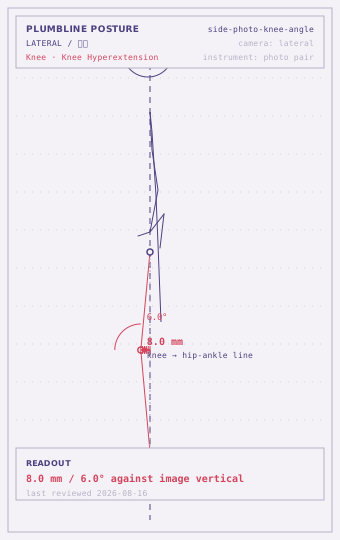
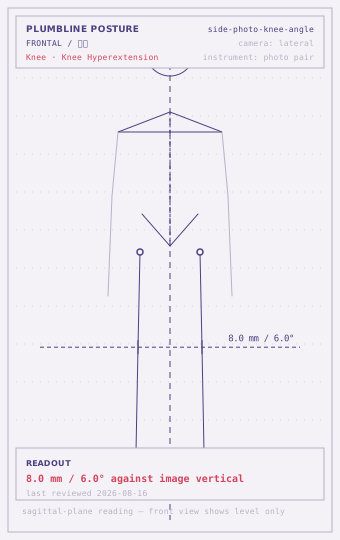
Within range
0-4 °Criterion: The relaxed frame shows 4 degrees or less between the thigh line and the shank line, and the deliberate extension frame adds no more than 2 degrees.
The knee stops at neutral and there is little extra range to take. Nothing here needs changing.
Borderline
5-10 °Criterion: 5 to 10 degrees at rest, or the deliberate frame adds more than 5 degrees, or the two frames look clearly different from each other.
The end of the range is available and the person is resting past it. The heel raise lock check at this station reads the same joint under load and is the next one to run.
Deviated
over 10 °Criterion: More than 10 degrees at rest, or the knee cannot be brought to neutral by any voluntary effort, or the position comes with a sensation of the joint shifting.
A knee that cannot be brought back to neutral, or that gives a shifting sensation, is a stability question rather than a postural one. Get it examined before training it.
| Tier | What to do |
|---|---|
| Low | Reading sits in the within-range band and is symmetric side to side: re-measure every 8–12 weeks and record which way the number is moving. |
| Moderate | Reading sits in the borderline band, or the two sides differ clearly: re-measure every 4–6 weeks and log the daily trigger (hours seated, one-sided load). Change the situation before adding anything to the routine. |
| High | Reading sits in the deviated band, or several screens at the same station all read deviated: get a clinician to rule out a structural or neural cause before continuing to self-screen. |
| Referral threshold | A knee that locks and cannot be unlocked, that gives way under load, or that swells after standing, needs assessment rather than a photograph. |
Commonly co-occurring
How to read this
Two frames, one joint
The knee is a hinge, and the question this screen asks is where the hinge stops. A photograph of a relaxed standing leg answers half of it; a photograph of the same leg deliberately straightened answers the other half. Read together they separate three situations that look identical in a mirror.
The first is a knee that rests at neutral, which needs nothing. The second is a knee that has the range to go past neutral and habitually does. The third is a knee whose end of range has moved, so that straight is no longer reachable at all.
Procedure
Stand side-on with the weight even, feet in their usual turnout, on a marked spot. Camera at knee height, roughly level with the kneecap.
Take the relaxed frame. Then straighten the knee as far as it will go, without lifting the heel or rolling the foot, and take the second frame from the same spot.
Measure the angle between the thigh line and the shank line on both frames. Record both numbers, not just the difference.
Reading it
Four degrees or less at rest, with no more than two degrees added by the extended frame, is the reference. Five to ten degrees at rest, or a large gap between the frames, means the joint has the range and the person is resting beyond it.
More than ten degrees, or a knee that cannot be brought back to neutral at all, or one that feels like it shifts when it is straightened, moves out of posture territory. Have it examined rather than photographing it again.
Keeping the series
The number is only useful against the same number taken the same way. Same spot, same camera height, same time of day, same footwear — which for this screen means none. Write all four facts down beside the result, because a photo series without them cannot be compared to anything.
Questions
Why two frames instead of one?
Because a single frame cannot tell a knee that is being held straight from a knee whose end of range has moved. The extended frame shows where the joint stops when the person tries, and the difference between the frames is the part that habit is responsible for.
Camera at knee height — how exact?
Roughly level with the kneecap. Camera height changes the apparent angle more than a small change in posture does, so pick a height and use it for every photo in the series.
Does it matter which leg?
Measure both and record them separately. A difference between sides is common and is worth watching, but it means the two legs cannot be pooled into one number.
Disclaimer
This page is informational only. It is not a medical diagnosis and it is not treatment or rehabilitation advice. Run every self-screen inside a pain-free range; stop and see a clinician for pain, numbness, weakness, night pain, or anything that started after an injury. The readout criteria are drawn from healthy-adult norms — prior injury, surgery and individual variation all shift the numbers.
lastReviewed 2026-08-16 · record side-photo-knee-angle · published 2026-08-24