- Home
- Pelvis
- Anterior Pelvic Tilt
- Heel Slide Lumbar Check
Heel Slide Lumbar Check
Lie on your back, flatten the lower back, and slide one heel away until the back lifts. The distance the heel travels tells you whether the hip can extend without dragging the pelvis with it.
- Gear
- A firm flat surface and a partner who can watch the lower back, or a phone recording from the side.
- Stance
- Lie on the back with both knees bent and the feet flat, lower back resting in its natural curve.
- Duration
- 120 s
- Camera angle
- lateral, lens level with the landmark
- Position
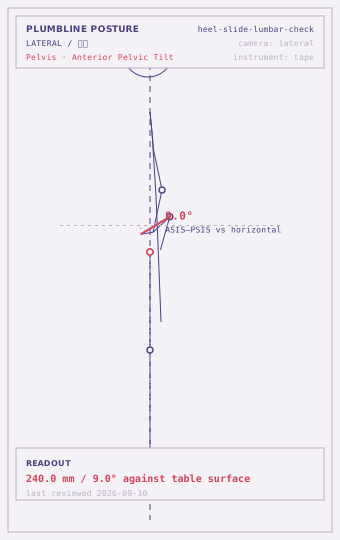
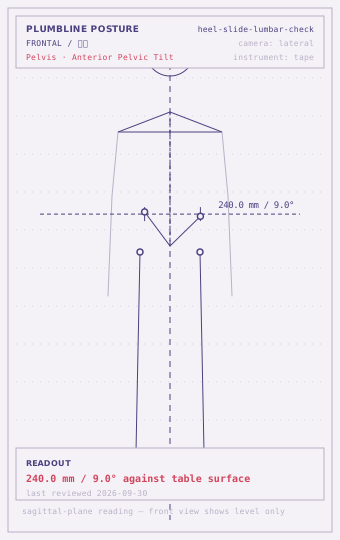
- Flatten the lower back gently against the surface, hold it flat, then slide one heel away until the back starts to lift. The distance the heel travels is the reading.
Bone landmarks
-
ASIS — coordinate id
asis -
L3 spinous process — coordinate id
lumbar -
Lateral knee line — coordinate id
knee-lateral -
Greater trochanter — coordinate id
greater-trochanter
Within range
over 450 mmCriterion: The heel slides more than 450 mm from the starting position before the lower back lifts off the surface.
The pelvis can hold a neutral position while the hip extends. Hip extension is not the limiting factor in the tilt.
Borderline
200-450 mmCriterion: The back lifts after 200 to 450 mm of slide, or the person has to press the back down deliberately to keep it flat for that distance.
The pelvis follows the hip earlier than expected. Record the distance; it is the number that moves when hip mobility or the daily sitting position changes.
Deviated
under 200 mmCriterion: Under 200 mm, or the back cannot be held flat at all before the slide begins, or the movement produces pain in the front of the hip.
A hip that cannot extend without taking the pelvis with it will hold an anterior tilt whatever the person does standing. Test the hip's extension range directly before continuing.
| Tier | What to do |
|---|---|
| Low | Reading sits in the within-range band and is symmetric side to side: re-measure every 8–12 weeks and record which way the number is moving. |
| Moderate | Reading sits in the borderline band, or the two sides differ clearly: re-measure every 4–6 weeks and log the daily trigger (hours seated, one-sided load). Change the situation before adding anything to the routine. |
| High | Reading sits in the deviated band, or several screens at the same station all read deviated: get a clinician to rule out a structural or neural cause before continuing to self-screen. |
| Referral threshold | A hip that pinches, clicks or gives way during the slide, or any pain in the groin, needs an assessment rather than more sliding. |
Commonly co-occurring
How to read this
Testing the direction the pelvis cannot go
Anterior tilt is usually described as a position of the pelvis. It is often better described as a consequence: the pelvis tilts forward because the hip will not let it go back without losing contact with the ground.
This screen measures exactly that. Lying on the back with the lower back flattened, the pelvis is fixed in neutral. Extending the hip by sliding the heel away can only continue as long as the hip joint has the range to allow it. The moment it runs out, the pelvis rotates forward to follow, and the lower back lifts.
Procedure
Lie on your back, knees bent, feet flat. Flatten the lower back by gently drawing the pelvis toward the ribs until the curve just contacts the surface — no pressing. Mark where the heel starts with a finger or a piece of tape.
Slide the heel away along the surface, keeping the knee bent and the pelvis still, until the lower back lifts off. Stop there and measure from the starting mark. Repeat on the other side, and repeat twice per side for reliability.
Reading the distance
Distance is a proxy for hip extension range under a fixed pelvis. Long distances mean the hip has room and the tilt is being chosen; short distances mean the hip is imposing the tilt. Those two have completely different remedies, and the difference between sides adds a third reading that often explains a one-sided lower back ache.
When to stop
If the movement produces a pinch at the front of the hip or a deep pain in the groin, stop. Those are not flexibility findings, and pushing a hip through them is how a range problem becomes a joint problem.
Questions
How flat is flat?
The natural curve reduced to just touching the surface, not pressed into it. Pressing hard recruits the abdominal wall and changes the test into a strength measurement. Flatten until you feel contact, no further.
Which leg should I slide?
Both, on separate attempts. A difference between sides is common and points at a hip problem on the shorter side rather than a general tilt pattern. Record both distances.
Does the knee have to stay bent?
Yes, at the starting angle, and the heel stays on the surface. Straightening the knee changes the hip's position and the test stops measuring extension range.
Disclaimer
This page is informational only. It is not a medical diagnosis and it is not treatment or rehabilitation advice. Run every self-screen inside a pain-free range; stop and see a clinician for pain, numbness, weakness, night pain, or anything that started after an injury. The readout criteria are drawn from healthy-adult norms — prior injury, surgery and individual variation all shift the numbers.
lastReviewed 2026-09-30 · record heel-slide-lumbar-check · published 2026-10-11