- Home
- Knee
- Knee Hyperextension
- Quad Set Lag Check
Quad Set Lag Check
Press the back of the knee into a towel and lift the heel. How much the heel lags behind the thigh's contraction is the last few degrees of extension, measured without any load on the leg.
- Gear
- A firm flat surface, a rolled towel, and a hand on the thigh.
- Stance
- Lie on the back with a rolled towel under the knee, legs straight, hands at the sides.
- Duration
- 90 s
- Camera angle
- lateral, lens level with the landmark
- Position
- Tighten the thigh to press the back of the knee into the towel, then lift the heel. Note how far the heel lags behind the thigh's contraction.
Bone landmarks
-
Lateral knee line — coordinate id
knee-lateral -
Greater trochanter — coordinate id
greater-trochanter -
Lateral malleolus — coordinate id
lateral-malleolus
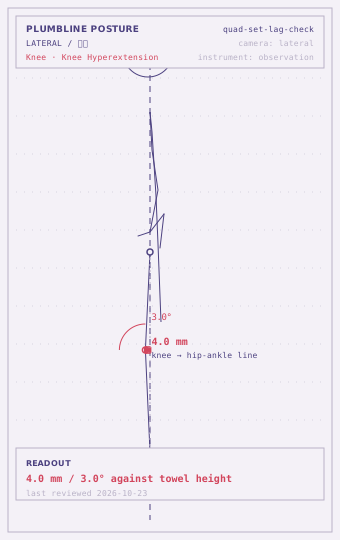
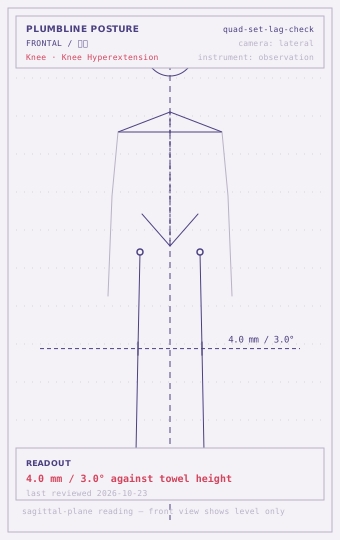
Within range
3 gradeCriterion: The thigh tightens, the back of the knee presses into the towel, and the heel lifts at the same moment with no visible delay.
The quadriceps can straighten the knee against gravity without a lag. This is the strength floor the other knee screens assume.
Borderline
2 gradeCriterion: The thigh tightens and the heel lifts, but with a visible lag or a small amount of knee bend remaining that clears only after the heel is up.
The last few degrees are the hard ones and they are the ones that matter. Read it beside the seated endpoint screen, which measures the same degrees unloaded.
Deviated
0-1 gradeCriterion: The thigh tightens but the heel does not lift, or the knee cannot be pressed into the towel at all, or the attempt produces pain.
An inability to lift the heel with the thigh contracted is a strength finding, and it is the one to deal with before any of the standing screens at this station.
| Tier | What to do |
|---|---|
| Low | Reading sits in the within-range band and is symmetric side to side: re-measure every 8–12 weeks and record which way the number is moving. |
| Moderate | Reading sits in the borderline band, or the two sides differ clearly: re-measure every 4–6 weeks and log the daily trigger (hours seated, one-sided load). Change the situation before adding anything to the routine. |
| High | Reading sits in the deviated band, or several screens at the same station all read deviated: get a clinician to rule out a structural or neural cause before continuing to self-screen. |
| Referral threshold | Pain during the attempt, or a knee that cannot be straightened by any means, should be assessed rather than trained. |
Commonly co-occurring
How to read this
The last few degrees
Straightening a knee sounds like one action and is really two: bringing it to near-straight, which most legs manage, and finishing the last few degrees, which is where quadriceps strength is actually tested. The last part is the part that disappears first in people who sit all day.
This screen isolates it. With the knee propped on a towel and the heel on the surface, the leg is asked to do the finishing move without any help from the hip or the ankle.
Procedure
Lie on the back with a rolled towel under the knee, the other leg straight and comfortable. Put a hand on the front of the thigh.
Tighten the thigh until the back of the knee presses into the towel. Then lift the heel off the surface, keeping the knee pressed down. Watch the order: the thigh should tighten first and the heel should follow immediately.
Do three repetitions and note the lag on the last one, which is usually the clearest.
Reading it
A thigh that tightens, a knee that presses down, and a heel that lifts at the same moment is the reference. A visible lag, or a few degrees of bend that clear only after the heel is up, means the last degrees are the weak ones.
A thigh that tightens with no heel lift at all, or a knee that cannot be pressed into the towel, is a strength finding rather than a posture one, and it changes how the standing screens at this station should be read.
Where it fits
Two of the screens at this station ask the knee to control its endpoint with the body’s weight on it. Both of them assume this reading is clean. When it is not, the loaded screens are not measuring what they claim to, which is the practical reason this unglamorous little test comes first.
Questions
How thick should the towel be?
A rolled hand towel is about right — thick enough that pressing the knee down is a real movement, thin enough that full extension is still reachable. A thick pillow removes the movement you are trying to see.
Should the heel lift high?
No. It only has to come off the surface, and only once the back of the knee is pressed down. Lifting the heel first and pressing the knee down afterwards is the pattern the screen exists to catch.
Why not just test it standing?
Because standing lets the hip and the ankle help. Supine with the towel removes both, so a failure here is specifically about the quadriceps' last degrees rather than about the whole leg.
Disclaimer
This page is informational only. It is not a medical diagnosis and it is not treatment or rehabilitation advice. Run every self-screen inside a pain-free range; stop and see a clinician for pain, numbness, weakness, night pain, or anything that started after an injury. The readout criteria are drawn from healthy-adult norms — prior injury, surgery and individual variation all shift the numbers.
lastReviewed 2026-10-23 · record quad-set-lag-check · published 2026-10-28