- Home
- Knee
- Knee Hyperextension
- Seated Knee Extension Endpoint
Seated Knee Extension Endpoint
Straighten the knee in sitting with a hand on the thigh. Whether the movement ends in muscle or in a hard stop is the difference between an endpoint that is controlled and one that is merely reached.
- Gear
- A hard chair, a bare foot, and a hand resting on the front of the thigh.
- Stance
- Sit well back on a hard chair so the knee is clear of the seat's edge, thigh supported, foot off the floor.
- Duration
- 120 s
- Camera angle
- lateral, lens level with the landmark
- Position
- Straighten the knee fully and hold. Feel whether the endpoint is a muscular stop or a hard stop, and note whether the knee can be pushed past it.
Bone landmarks
-
Lateral knee line — coordinate id
knee-lateral -
Lateral malleolus — coordinate id
lateral-malleolus -
Greater trochanter — coordinate id
greater-trochanter
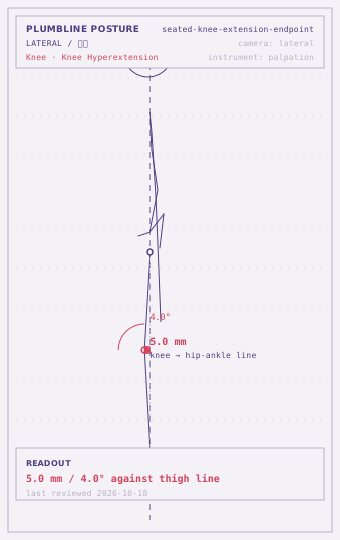
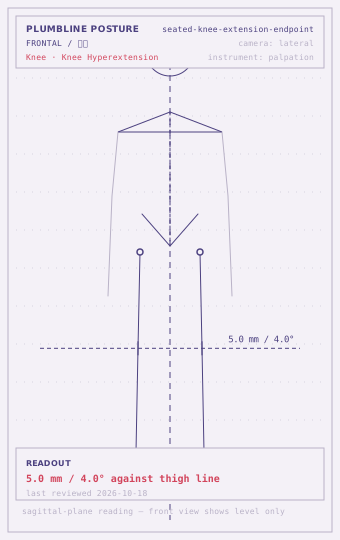
Within range
3 gradeCriterion: The full extension is reached with a firm, muscular stop, the thigh stays relaxed under the hand, and no further movement is available.
The quadriceps is doing the work of ending the movement. This is the endpoint control that the loaded screens at this station assume exists.
Borderline
2 gradeCriterion: Full extension is reached but the thigh tightens hard under the hand, or a small amount of further movement is available when the knee is pressed.
The endpoint is being reached but not held. Read it beside the heel raise lock check, which asks the same question with the leg loaded.
Deviated
0-1 gradeCriterion: The knee cannot be straightened fully while sitting, or straightening causes pain, or the endpoint is a hard stop with no muscular feel at all.
An extension that cannot be reached, or one that is painful, is a joint finding. Have it examined rather than working on the habit.
| Tier | What to do |
|---|---|
| Low | Reading sits in the within-range band and is symmetric side to side: re-measure every 8–12 weeks and record which way the number is moving. |
| Moderate | Reading sits in the borderline band, or the two sides differ clearly: re-measure every 4–6 weeks and log the daily trigger (hours seated, one-sided load). Change the situation before adding anything to the routine. |
| High | Reading sits in the deviated band, or several screens at the same station all read deviated: get a clinician to rule out a structural or neural cause before continuing to self-screen. |
| Referral threshold | A knee that cannot be fully straightened, or where straightening is painful, should be assessed before anything else is measured. |
Commonly co-occurring
How to read this
Where the movement ends
Every joint has an endpoint, and the useful question about a knee endpoint is what is producing it. A movement that ends because the muscle has run out of range feels different under the hand from one that ends because the joint has arrived at its limit. The first is control. The second is structure.
In sitting, the difference is easy to feel and easy to miss, because most people never test it without also pushing the knee against something.
Procedure
Sit well back on a hard chair so the knee is clear of the seat’s edge and the thigh is supported. Let the foot hang free.
Put a hand on the front of the thigh. Straighten the knee fully and hold. Note two things: whether the thigh tightens under the hand as the movement finishes, and whether any further movement can be produced by pressing the knee gently backward.
Reading it
A firm muscular stop, a relaxed thigh, and no further movement is the reference. Full extension with a hard-tightening thigh, or with a little extra movement available under pressure, means the endpoint is being reached but not held.
Not reaching full extension at all, or pain on straightening, is a different category. That is a joint that should be examined, and no amount of endpoint practice will change it.
What it is for
This screen is the quiet prerequisite of the loaded tests at this station. Both the heel raise lock check and the step-down screen assume the person can reach and hold a neutral knee; if they cannot, the readings those screens produce are about a joint that is not where the test thinks it is.
Questions
Why sit well back on the chair?
Because the front edge of the seat is the most common thing that decides this reading. If the knee is pressing against it, the chair is setting the endpoint. Move back so the knee is clear and the leg has to hold itself.
What does a muscular stop feel like?
The thigh tightens and the movement runs out gradually, the way it does at the end of a biceps curl. A hard stop feels like the movement simply arrived, with the thigh still soft under the hand.
Should the foot be off the floor?
Yes. A foot on the floor lets the ankle and hip contribute and turns the movement into a whole-leg action. The foot hangs free so the knee is the only thing being asked.
Disclaimer
This page is informational only. It is not a medical diagnosis and it is not treatment or rehabilitation advice. Run every self-screen inside a pain-free range; stop and see a clinician for pain, numbness, weakness, night pain, or anything that started after an injury. The readout criteria are drawn from healthy-adult norms — prior injury, surgery and individual variation all shift the numbers.
lastReviewed 2026-10-18 · record seated-knee-extension-endpoint · published 2026-10-26