- Home
- Pelvis
- Posterior Pelvic Tilt
- Seated Slump Timer
Seated Slump Timer
Sit tall on a plain chair and time how long it lasts. The interesting number is not the minutes — it is whether the slump was noticed when it happened.
- Gear
- An ordinary chair, a timer, and a way to notice the moment the pelvis rolls back.
- Stance
- Sit tall on the front half of the chair with the feet flat, then let the pelvis roll back into your usual slumped position.
- Duration
- 300 s
- Camera angle
- lateral, lens level with the landmark
- Position
- Return to tall sitting. Start the timer and hold tall without leaning on the backrest. Stop when the pelvis has rolled back and cannot be noticed returning.
Bone landmarks
-
L3 spinous process — coordinate id
lumbar -
Sacrum — coordinate id
sacrum -
C7 spinous process — coordinate id
c7
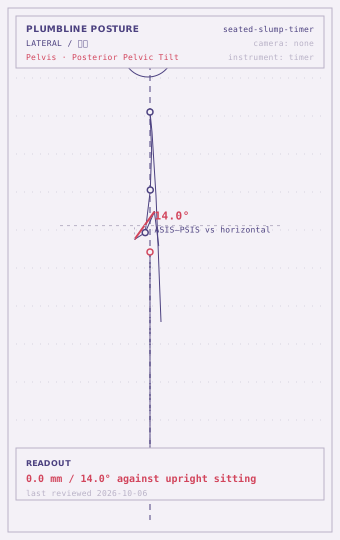
Within range
over 10 minCriterion: Tall sitting is held for over ten minutes with normal breathing and no backrest, and the pelvis is still tall when the timer stops.
Sitting posture is not the limiting factor in this person's day. Re-check after any change in desk or chair.
Borderline
3-10 minCriterion: Between three and ten minutes, or the position only holds with the abdominal wall braced hard, or the person cannot say when the pelvis rolled back.
The third clause is the important one: a pelvis that rolls back unnoticed cannot be corrected by reminding oneself to sit up. Change the chair's seat angle first.
Deviated
under 3 minCriterion: Under three minutes, or the pelvis cannot be brought to a tall position at all without lifting the feet or sliding forward off the seat.
A pelvis that cannot reach tall sitting on that chair is being blocked by the seat, not by habit. Measure the seat before measuring the person.
| Tier | What to do |
|---|---|
| Low | Reading sits in the within-range band and is symmetric side to side: re-measure every 8–12 weeks and record which way the number is moving. |
| Moderate | Reading sits in the borderline band, or the two sides differ clearly: re-measure every 4–6 weeks and log the daily trigger (hours seated, one-sided load). Change the situation before adding anything to the routine. |
| High | Reading sits in the deviated band, or several screens at the same station all read deviated: get a clinician to rule out a structural or neural cause before continuing to self-screen. |
| Referral threshold | Slumping that comes with leg pain, numbness or a change in bowel or bladder control is not a posture problem and needs urgent assessment. |
Commonly co-occurring
How to read this
Two ways to fail a timer
This screen looks like a sitting-stamina test and is really a test of self-perception. Almost nobody holds tall sitting for a whole working morning, and that is not the finding. The finding is whether the moment the pelvis rolls back registers at all.
People who notice the slump and correct it a dozen times an hour are in a good position: the position is available and the attention is present. People who cannot say when it happened are in a different one, and the fix is furniture rather than attention.
Running it
Sit on the front half of a plain chair, feet flat, no backrest. Let the pelvis roll back into the slump once, so you know what you are watching for; then return to tall.
Start the timer. Hold tall and stay with it. Stop when the pelvis has rolled back and stayed there — and try to note whether you caught it as it happened or only found it afterwards.
Reading the result
Over ten minutes with no bracing and no backrest is a strong result and means the chair is not fighting you. Three to ten minutes is the common middle: the position is available but not maintained.
Under three minutes, or an inability to reach tall sitting at all on that chair, points at the seat itself. A seat that slopes backward makes posterior tilt the default, and no amount of sitting practice overcomes a slope that steep.
Using it on the chair
The most useful version of this screen is the comparison. Time it on the office chair, then on a dining chair, then on the floor if you like. If the number changes by a factor of three between two chairs, the chair is the variable that matters, and it is also the cheapest one to change.
Questions
Can I lean on the backrest?
Not for this screen. The backrest does the work the pelvis should be doing, and using it turns the reading into a measure of the chair. Test the backrest separately if you like, but score the two separately.
What counts as tall?
The version of sitting where the pelvis has not rolled back — the front of the pelvis is not tipped up toward the ribs and the lower back has not lost its curve. If you have run the wall screen, tall sitting is the seated version of the three-point contact.
Why does it matter whether I noticed?
Because the two failure modes need opposite fixes. A slump that is noticed and corrected needs a reminder; a slump that happens without being noticed needs a different chair, since no amount of attention catches it.
Disclaimer
This page is informational only. It is not a medical diagnosis and it is not treatment or rehabilitation advice. Run every self-screen inside a pain-free range; stop and see a clinician for pain, numbness, weakness, night pain, or anything that started after an injury. The readout criteria are drawn from healthy-adult norms — prior injury, surgery and individual variation all shift the numbers.
lastReviewed 2026-10-06 · record seated-slump-timer · published 2026-10-17