- Home
- Pelvis
- Posterior Pelvic Tilt
- Wall Occiput-Thorax-Sacrum Check
Wall Occiput-Thorax-Sacrum Check
Three contact points against a wall. Which ones reach it without effort, and which one is lost first, is the reading — and the flatter curve is the one people miss.
- Gear
- A bare wall and a partner who can see the gap between the back and the wall.
- Stance
- Stand with the back to the wall, heels about 150 mm out, and bring the head, upper back and sacrum toward the wall in that order.
- Duration
- 90 s
- Camera angle
- lateral, lens level with the landmark
- Position
- Note which of the three contact points reach the wall without effort and which need a push. Then hold the contact for 30 seconds and see which one is lost first.
Bone landmarks
-
Occiput — coordinate id
occiput -
C7 spinous process — coordinate id
c7 -
Sacrum — coordinate id
sacrum -
L3 spinous process — coordinate id
lumbar
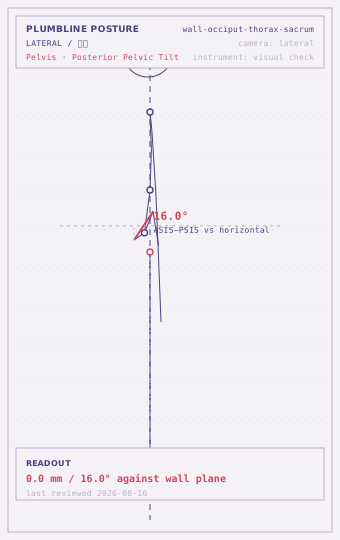
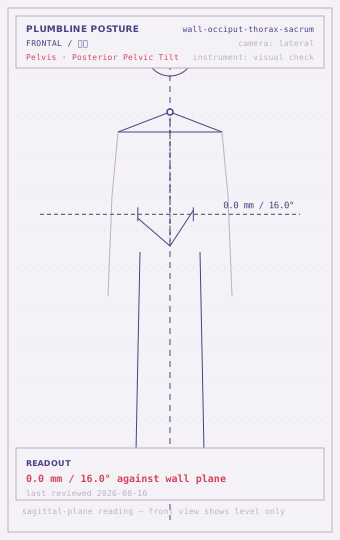
Within range
3 pointCriterion: All three points — occiput, thoracic spine and sacrum — contact the wall easily and stay in contact for 30 seconds.
The spine's curves are within the range a flat wall can accept. This is the reference for the other posterior-tilt screens.
Borderline
2 pointCriterion: Two of the three points contact easily, or the third reaches the wall only by tucking the chin or pulling the ribs down, or contact is lost during the hold.
One curve is flatter than the wall expects. Note which point fails, because the upper and lower failures have different causes.
Deviated
0-1 pointCriterion: Only one point contacts, or the sacrum cannot be brought to the wall at all without lifting the heels, or the lumbar curve is flat in standing and stays flat when asked to arch.
A lumbar curve that is absent and cannot be produced on request is a movement finding rather than a carriage habit. Measure the spine's extension before continuing.
| Tier | What to do |
|---|---|
| Low | Reading sits in the within-range band and is symmetric side to side: re-measure every 8–12 weeks and record which way the number is moving. |
| Moderate | Reading sits in the borderline band, or the two sides differ clearly: re-measure every 4–6 weeks and log the daily trigger (hours seated, one-sided load). Change the situation before adding anything to the routine. |
| High | Reading sits in the deviated band, or several screens at the same station all read deviated: get a clinician to rule out a structural or neural cause before continuing to self-screen. |
| Referral threshold | A flat lumbar spine that came with an injury, or that comes with leg weakness or numbness, needs a clinician rather than a wall test. |
Commonly co-occurring
How to read this
The tilt nobody looks for
Posterior pelvic tilt gets a fraction of the attention anterior tilt gets, and it is more common in people who sit for long hours. It is also easy to mistake for good posture. The person looks upright, the lower back looks flat, and the mirror agrees — while the lumbar curve has disappeared and the load has moved to the back of the spine.
This screen finds it with three contact points, and it takes less than a minute.
Procedure
Stand with the back to a bare wall, heels about 150 mm out. Bring the sacrum to the wall first, then the upper back, then the head, without lifting the chin to get there. Note which of the three reach the wall on their own.
Then hold the contacts for thirty seconds and see which one is lost first. Write down both observations.
Reading it
Three points and a stable hold is the reference. Two points, or a point that only arrives with a chin lift or a rib pull, means one of the spine’s curves has flattened beyond what a wall will accept. Which point fails tells you where: a lost upper back contact points at the thoracic spine, a lost sacral contact points at the pelvis, and a lost head contact usually accompanies the first.
The failure during the hold is the third observation, and it is the one that distinguishes a position that is being held from one that is simply not being noticed.
What it cannot say
The wall is a flat plane and spines are not. Body composition, a large rib cage and a long-standing training history all change which points contact, and people with no symptoms at all fail one of the three. Read it as a description of the shape the spine is holding, track it over time, and pair it with a screen that measures the pelvis itself before acting on it.
Questions
My heels lift when I put my sacrum on the wall. Is that a fail?
It is a separate finding, so record it rather than fighting it. Heels lifting means the hamstrings or calves are limiting the position, and pushing through it changes the contact points. Note it and read the three points as they are.
Why does the head count as a contact point?
Because if the occiput will not reach the wall without lifting the chin, the upper spine has flattened too, which is the same pattern as the lower one. The two often travel together and a screen that ignores the head will report a flat lumbar spine as an isolated finding.
How long should the hold be?
Thirty seconds. A contact that survives thirty seconds of ordinary breathing is a position the body holds; one that is lost in five seconds was produced by a push and is not a resting position at all.
Disclaimer
This page is informational only. It is not a medical diagnosis and it is not treatment or rehabilitation advice. Run every self-screen inside a pain-free range; stop and see a clinician for pain, numbness, weakness, night pain, or anything that started after an injury. The readout criteria are drawn from healthy-adult norms — prior injury, surgery and individual variation all shift the numbers.
lastReviewed 2026-08-16 · record wall-occiput-thorax-sacrum · published 2026-08-21