- Home
- Pelvis
- Anterior Pelvic Tilt
- Wall Lumbar Gap in Finger Widths
Wall Lumbar Gap in Finger Widths
Stand against a wall and slide a flat hand under the lower back. The count in finger-widths is the reading — and so is the count after tucking the pelvis.
- Gear
- A bare wall and a partner, or a phone camera at waist height.
- Stance
- Stand with the back to the wall, heels about 150 mm out, head and sacrum lightly touching, arms relaxed.
- Duration
- 60 s
- Camera angle
- lateral, lens level with the landmark
- Position
- Slide a flat hand into the space between the lower back and the wall and count how many finger-widths fit. Then tuck the pelvis gently and count again.
Bone landmarks
-
L3 spinous process — coordinate id
lumbar -
Sacrum — coordinate id
sacrum -
Occiput — coordinate id
occiput -
C7 spinous process — coordinate id
c7
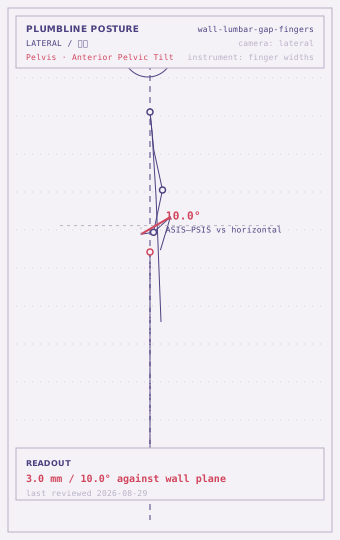
Within range
0-1 fingerCriterion: One flat palm fits with the fingers parallel to the floor, and tucking the pelvis closes the gap almost completely.
The lumbar curve is within the range that wall contact can accommodate. This is the reference for the other pelvic screens.
Borderline
1.5-3 fingerCriterion: Between one and a half and three finger-widths, and tucking the pelvis closes at least half of the gap.
A deeper curve that the pelvis can still change. Record the resting and tucked counts, because the difference is what moves first when the sitting position changes.
Deviated
over 3 fingerCriterion: More than three finger-widths, or the gap barely changes when the pelvis is tucked, or the ribs flare forward and the chest sits behind the wall line.
A gap that survives the tuck means the curve is not being produced by the pelvis alone. Read the thoracic position in the same frame before deciding what to change.
| Tier | What to do |
|---|---|
| Low | Reading sits in the within-range band and is symmetric side to side: re-measure every 8–12 weeks and record which way the number is moving. |
| Moderate | Reading sits in the borderline band, or the two sides differ clearly: re-measure every 4–6 weeks and log the daily trigger (hours seated, one-sided load). Change the situation before adding anything to the routine. |
| High | Reading sits in the deviated band, or several screens at the same station all read deviated: get a clinician to rule out a structural or neural cause before continuing to self-screen. |
| Referral threshold | Back pain after a fall, night pain that wakes you, or any change in bladder or bowel control needs urgent assessment. |
Commonly co-occurring
How to read this
A crude test read carefully
The wall lumbar gap is the most widely repeated pelvic screen and the most widely abused one, because the bare count means almost nothing. Almost everyone fits a hand under the lower back against a wall. Reporting a two-finger gap as a finding without the second measurement is how a normal range becomes a diagnosis.
Read as a pair of counts, it becomes useful: how deep the gap is at rest, and how deep it is after the pelvis is tucked.
Procedure
Stand with the back to a bare wall, heels about 150 mm out so the body is not leaning. Bring the head and the sacrum lightly to the wall. Slide one flat hand, fingers parallel to the floor, sideways into the gap under the lower back, and count the finger-widths that fit at the deepest point.
Then tuck the pelvis gently — as if rolling the front of the pelvis up toward the ribs — and count again. Write both numbers.
Reading the difference
The resting count alone is a description of the lumbar curve’s depth, which varies with body shape, training history and how the person happens to be standing. The difference between the two counts is a statement about how much of that curve the pelvis controls.
A gap that closes by two finger-widths on the tuck is pelvis-driven. A gap that barely changes is being held by something the pelvis cannot affect, and the thoracic position in the same standing frame is where to look next.
What it does not measure
It does not measure the tilt angle, and it does not distinguish a deep curve caused by anterior tilt from a deep curve caused by a large rib cage or a thick layer of tissue. The photo angle screen at this station is the one to pair with it.
Questions
Fingers which way?
Parallel to the floor, palm flat against the lower back, sliding sideways into the gap. Fingers pointing down changes the geometry and lets almost anything fit.
Does everyone not have a gap there?
Yes, and that is exactly why the bare count is close to useless. Almost everyone fits one hand. The useful readings are the second count taken after tucking the pelvis, and the difference between the two.
Why finger-widths and not millimetres?
Because the wall test is not precise enough to deserve millimetres, and a count is easier to reproduce without a partner. If you want a number, measure the depth of the gap with a ruler at the deepest point, and record that alongside the count.
Disclaimer
This page is informational only. It is not a medical diagnosis and it is not treatment or rehabilitation advice. Run every self-screen inside a pain-free range; stop and see a clinician for pain, numbness, weakness, night pain, or anything that started after an injury. The readout criteria are drawn from healthy-adult norms — prior injury, surgery and individual variation all shift the numbers.
lastReviewed 2026-08-29 · record wall-lumbar-gap-fingers · published 2026-09-05