- Home
- Knee
- Knee Hyperextension
- Single-Leg Stance Knee
Single-Leg Stance Knee
Stand on one bare foot with the other knee at hip height and time it. Whether the standing knee stays steady or takes over the balance work is the reading.
- Gear
- A clear floor, bare feet, and a timer.
- Stance
- Stand on one bare foot with the other knee lifted to hip height in front and the arms folded across the chest.
- Duration
- 60 s
- Camera angle
- frontal, lens level with the landmark
- Position
- Hold the position with the eyes open and time it. Stop when the free foot touches down, the lifted knee drops, or the standing knee moves more than a hand's width.
Bone landmarks
-
Greater trochanter — coordinate id
greater-trochanter -
Lateral knee line — coordinate id
knee-lateral -
Lateral malleolus — coordinate id
lateral-malleolus -
Navicular tuberosity — coordinate id
navicular
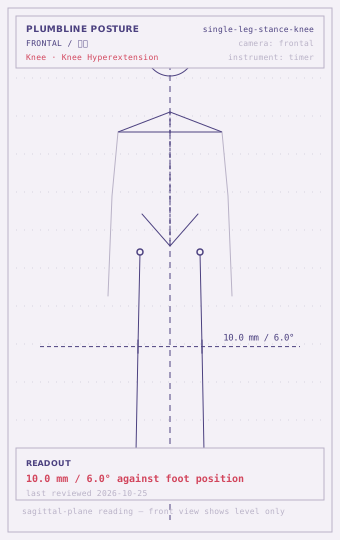
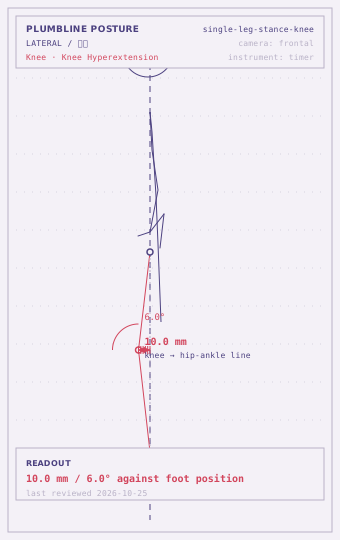
Within range
over 30 sCriterion: The position holds for over 30 seconds with the standing knee steady, the heel down and the lifted knee at hip height.
The leg can hold a narrow base without the knee compensating. This is the floor for the other single-leg screens at this station.
Borderline
10-30 sCriterion: Ten to thirty seconds, or the hold lasts only while the standing knee swings, the lifted knee drops below hip height, or the arms come out of the fold.
The narrow base is being managed from the knee rather than from the hip and foot. Read the ankle screens alongside this one.
Deviated
under 10 sCriterion: Under ten seconds, or the position cannot be taken without the standing knee being locked back to stay upright, or it is painful.
A single-leg stance that is only possible with the knee locked is a finding about the hip and the foot, and the knee is where the symptom is being reported rather than where the cause is.
| Tier | What to do |
|---|---|
| Low | Reading sits in the within-range band and is symmetric side to side: re-measure every 8–12 weeks and record which way the number is moving. |
| Moderate | Reading sits in the borderline band, or the two sides differ clearly: re-measure every 4–6 weeks and log the daily trigger (hours seated, one-sided load). Change the situation before adding anything to the routine. |
| High | Reading sits in the deviated band, or several screens at the same station all read deviated: get a clinician to rule out a structural or neural cause before continuing to self-screen. |
| Referral threshold | A single-leg stance that is painful, or that gives way, or that is limited by numbness in the foot, should be assessed. |
Commonly co-occurring
How to read this
A narrow base
Standing on two feet gives a wide base and hides almost everything. Standing on one converts every small postural adjustment into a visible event, and the question this screen asks is where those adjustments are coming from.
A leg that manages a narrow base well adjusts from the hip and the foot, with the knee staying quietly at neutral. A leg that manages it badly does the adjusting at the knee, which means the knee is being asked to correct for the hip and the ankle at the same time.
Procedure
Stand on one bare foot on a clear floor. Lift the other knee to about hip height in front, and fold the arms across the chest. No shoes, no wall, no support.
Start the timer and hold. Stop when the free foot touches down, when the lifted knee drops below hip height, when the arms come unfolded, or when the standing knee has swung more than a hand’s width.
Repeat on the other side and record both numbers separately.
Reading it
Over thirty seconds with a steady knee, a heel on the floor and the lifted knee held is a good result. Ten to thirty seconds, or a hold maintained by swinging the knee, is the common middle.
Under ten seconds, or a stance that is only possible with the knee locked backward, points away from the knee. The hip and the foot are the usual reasons a narrow base fails, and the ankle screens at this station are the ones to run next.
Two sides, two numbers
The comparison between sides is often more useful than either number. A difference of more than ten seconds between legs, taken on the same day with the same conditions, is worth following even when both sides clear the threshold, because it usually means one leg has stopped doing something the other still does.
Questions
Eyes open or closed?
Open for this screen. Eyes-closed stance measures a different system and is a much harder test with a much wider spread of normal results. Keep this one comparable.
Where does the free leg go?
Knee lifted to roughly hip height in front, not tucked against the standing leg. Tucking it against the standing leg gives a contact point and makes the balance far easier.
Is 30 seconds a lot?
It is a reasonable target and not a hard cutoff. The number that matters is your own, taken the same way each time. A person who starts at twelve seconds and reaches twenty-five has improved regardless of the threshold.
Disclaimer
This page is informational only. It is not a medical diagnosis and it is not treatment or rehabilitation advice. Run every self-screen inside a pain-free range; stop and see a clinician for pain, numbness, weakness, night pain, or anything that started after an injury. The readout criteria are drawn from healthy-adult norms — prior injury, surgery and individual variation all shift the numbers.
lastReviewed 2026-10-25 · record single-leg-stance-knee · published 2026-11-01