- Home
- Knee
- Knee Hyperextension
- Step-Down Knee Control
Step-Down Knee Control
Lower yourself off a step on one leg and film it from the front. The line the knee travels through, and whether the heel stays down, is the whole reading.
- Gear
- A step about 150 mm high, a wall or rail within reach, and a phone filming from the front.
- Stance
- Stand on the step on one leg, the other leg hanging free in front, fingertips on the wall for balance only.
- Duration
- 120 s
- Camera angle
- frontal, lens level with the landmark
- Position
- Bend the standing knee and lower the free heel toward the floor, then press back up. Film the whole descent and watch the line of the standing knee.
Bone landmarks
-
Greater trochanter — coordinate id
greater-trochanter -
Lateral knee line — coordinate id
knee-lateral -
Lateral malleolus — coordinate id
lateral-malleolus
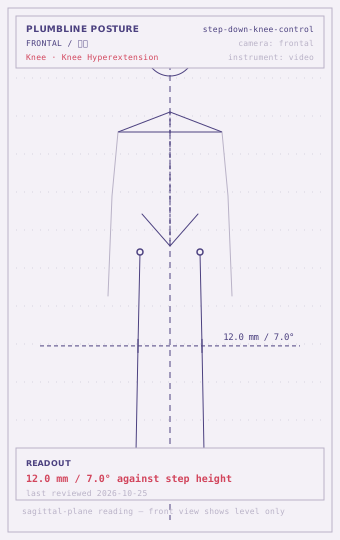
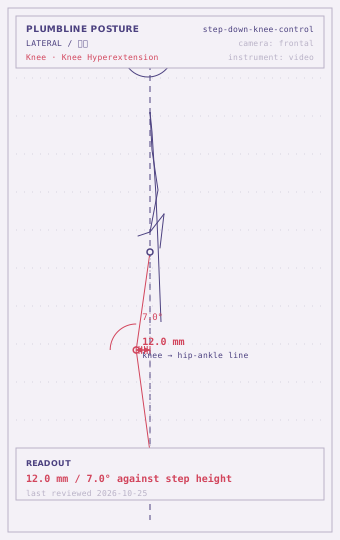
Within range
3 gradeCriterion: The standing knee travels forward over the middle of the foot, stays roughly over the second toe throughout the descent, and the heel stays down.
The knee is controlled through a loaded bend. The end-of-range position is not interfering with the movement.
Borderline
2 gradeCriterion: The knee drifts inward of the second toe, or the heel lifts, or the free foot touches down to steady the descent.
One of the three controls is missing. Note which one, because an inward drift and a heel lift have different causes and different screens.
Deviated
0-1 gradeCriterion: The step down cannot be performed without pain, or the knee gives way, or the descent cannot be controlled at any height.
Giving way under load is a stability finding and it comes before everything else at this station. Have it examined.
| Tier | What to do |
|---|---|
| Low | Reading sits in the within-range band and is symmetric side to side: re-measure every 8–12 weeks and record which way the number is moving. |
| Moderate | Reading sits in the borderline band, or the two sides differ clearly: re-measure every 4–6 weeks and log the daily trigger (hours seated, one-sided load). Change the situation before adding anything to the routine. |
| High | Reading sits in the deviated band, or several screens at the same station all read deviated: get a clinician to rule out a structural or neural cause before continuing to self-screen. |
| Referral threshold | A knee that gives way, that swells after activity, or that hurts enough to change how stairs are used, needs assessment before training. |
Commonly co-occurring
How to read this
Control, not strength
Stepping down is the movement that hurts most knees, and it is not because descending takes strength. It is because descending asks the leg to control a load while the knee is bending, and the control has to come from the thigh rather than from the joint’s end of range.
Most people who have trouble with stairs can climb without any problem. Climbing loads the knee in a position it can be strong in. Descending is where the control shows.
Procedure
Stand on a step about 150 mm high on one leg, the other leg hanging free in front. One fingertip on the wall for balance. Set a phone on the floor in front, filming at the level of the step.
Bend the standing knee and lower the free heel toward the floor in a slow count of three, then press back up. Film three repetitions.
Watch the film for two things: the line the standing knee travels through, and whether the heel stays on the step.
Reading it
A knee that travels forward over the middle of the foot, staying roughly over the second toe, with the heel down, is the reference. An inward drift, a lifted heel, or a free foot that touches down early each mean one control is missing.
Pain, giving way, or a descent that cannot be controlled at any height changes the category. That is a knee to have examined, and the screen should not be repeated until it has been.
Progress, measured honestly
The way to use this screen is to film the same three repetitions every few weeks at the same step and the same camera position. Progress looks like a knee that drifts inward less than it used to, or a heel that stays down where it used to lift. Both are visible on film, and both are more informative than whether the movement feels better.
Questions
How high should the step be?
About 150 mm — a stair riser, or a sturdy box. Higher makes the descent a strength test rather than a control test; lower does not ask the question.
Why film from the front?
Because the two things being looked at are sideways and vertical: whether the knee drifts inward of the second toe, and whether the heel stays down. Neither is visible from the side.
What if I need the wall?
Use it, but for a fingertip only, and write down that you used it. A hand that takes weight changes the movement enough to change the reading, and a reading with an unrecorded assist is not comparable to the next one.
Disclaimer
This page is informational only. It is not a medical diagnosis and it is not treatment or rehabilitation advice. Run every self-screen inside a pain-free range; stop and see a clinician for pain, numbness, weakness, night pain, or anything that started after an injury. The readout criteria are drawn from healthy-adult norms — prior injury, surgery and individual variation all shift the numbers.
lastReviewed 2026-10-25 · record step-down-knee-control · published 2026-10-30