- Home
- Shoulder Girdle
- Rounded Shoulders
- Acromion Plumb Photo
Acromion Plumb Photo
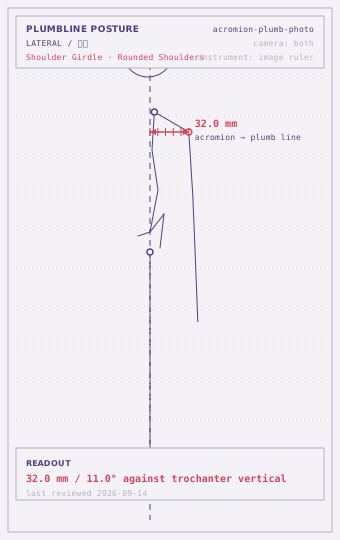
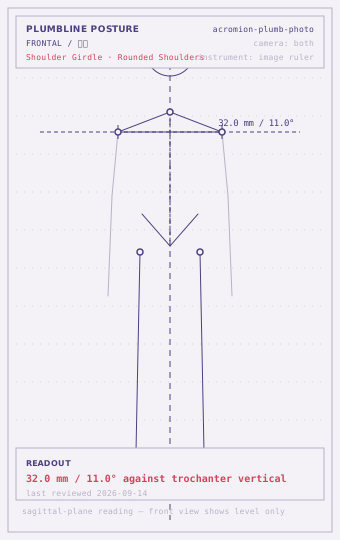
A side photograph with the acromion and the greater trochanter both marked. The horizontal distance between them answers whether the shoulder is stacked over the hip.
- Gear
- A phone on a tripod, a plain wall, and a ruler or grid overlay on the image.
- Stance
- Stand side-on, arms hanging relaxed, in your usual stance. Do not pull the shoulders back for the photograph.
- Duration
- 90 s
- Camera angle
- one frontal and one lateral frame
- Position
- Mark the acromion and the greater trochanter. Measure the horizontal distance by which the acromion sits forward of a vertical dropped through the trochanter.
Bone landmarks
-
Acromion — coordinate id
acromion -
Greater trochanter — coordinate id
greater-trochanter -
C7 spinous process — coordinate id
c7
Within range
0-20 mmCriterion: The acromion sits within 20 mm of the trochanter vertical on both sides when scaled against a known object in the frame.
The shoulder is stacked close to the hip line. Re-photograph in three months with the same camera distance.
Borderline
21-45 mmCriterion: The acromion sits 21 to 45 mm forward, or the two sides differ by more than 15 mm, or the offset closes by at least a third when the shoulder is drawn back.
Forward, but reversible. Compare this frame with the cued frame before deciding anything: a large closing difference means the position is available and not held.
Deviated
over 45 mmCriterion: More than 45 mm forward and the cued frame barely moves it, or the thoracic spine itself is well behind the trochanter vertical in the same frame.
When the thoracic position is driving the shoulder offset, correcting the shoulder is treating the wrong end of the chain. Read the whole frame before deciding.
| Tier | What to do |
|---|---|
| Low | Reading sits in the within-range band and is symmetric side to side: re-measure every 8–12 weeks and record which way the number is moving. |
| Moderate | Reading sits in the borderline band, or the two sides differ clearly: re-measure every 4–6 weeks and log the daily trigger (hours seated, one-sided load). Change the situation before adding anything to the routine. |
| High | Reading sits in the deviated band, or several screens at the same station all read deviated: get a clinician to rule out a structural or neural cause before continuing to self-screen. |
| Referral threshold | A shoulder offset that appeared after an injury, or that comes with a numb arm during the night, should be assessed. |
Commonly co-occurring
How to read this
Two points, one vertical, one number
The acromion is the bony point at the top of the shoulder, and it is the highest landmark of the shoulder girdle that can be found by eye on a photograph. The greater trochanter is the bony knob on the outside of the hip, found by touching. A vertical dropped through the trochanter is a reasonable stand-in for the body’s line of load.
Measure how far forward of that line the acromion sits, and you have a number that describes how far the shoulder girdle has been carried off the rib cage.
Making it repeatable
Four things change the number, and all four need to be fixed if the series is to mean anything.
- Camera distance. Measure it and write it down. Perspective changes the apparent offset by several millimetres across a one-metre change in distance.
- Camera height. At hip height the shoulder appears more forward; at shoulder height less. Pick shoulder height.
- The arm position. Hanging, relaxed. A slightly bent elbow moves the acromion.
- Camera level. 3 degrees of tilt is 3 degrees added to every vertical in the frame.
Also photograph a cued frame, with the shoulder drawn gently back. The difference between the two frames is the part of the offset the person can remove voluntarily, which is the part that responds to a change in setup.
What the number does not say
It does not say the shoulder is “wrong”. Shoulders sit forward of the hip line in a large proportion of people with no symptoms at all, and the published ranges overlap heavily between groups with and without pain. Read it as a description of where the shoulder is carried, track it over months, and treat a change in the series as more meaningful than the absolute value.
Questions
How do I scale millimetres off a photograph?
Include something of known size in the frame — a sheet of A4 held against the wall behind you is the easiest. Measure its apparent width in pixels, divide by its real width in millimetres, and you have a scale. Without that, the offset can only be compared between your own photographs taken at the same distance, never converted to millimetres at all.
Should the arms hang or be raised?
Hanging, relaxed, exactly as in the reference photographs the ranges come from. Raising the arms changes the scapular position and moves the acromion by a centimetre or more, which is larger than the effect being measured.
Is this the same as the tragus angle?
No, and they often disagree. The tragus angle reads the head; this reads the shoulder. Someone can have a head well forward with shoulders stacked, or the reverse. Take both from the same frame so the disagreement is visible rather than lost.
Disclaimer
This page is informational only. It is not a medical diagnosis and it is not treatment or rehabilitation advice. Run every self-screen inside a pain-free range; stop and see a clinician for pain, numbness, weakness, night pain, or anything that started after an injury. The readout criteria are drawn from healthy-adult norms — prior injury, surgery and individual variation all shift the numbers.
lastReviewed 2026-09-14 · record acromion-plumb-photo · published 2026-09-18