- Home
- Shoulder Girdle
- Rounded Shoulders
- Wall Scapula Contact
Wall Scapula Contact
Back to the wall, shoulder blades lightly pressed. The reading is how many blades keep contact, and which one gives up first when the effort is released.
- Gear
- A bare wall and a partner who can look at both shoulder blades at once, or a phone on a tripod behind you.
- Stance
- Stand with the back to the wall, feet about 150 mm out, head and sacrum lightly touching, arms relaxed at the sides.
- Duration
- 60 s
- Camera angle
- frontal, lens level with the landmark
- Position
- Press the shoulder blades lightly back without shrugging, and count how many of the two blades keep contact. Then release and note which one loses contact first.
Bone landmarks
-
Left acromion — coordinate id
acromion-l -
Right acromion — coordinate id
acromion-r -
C7 spinous process — coordinate id
c7 -
Scapular spine — coordinate id
scapular-spine
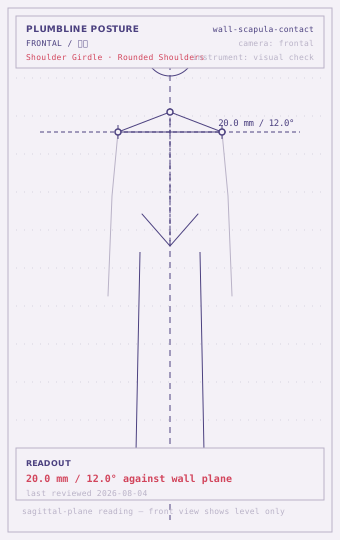
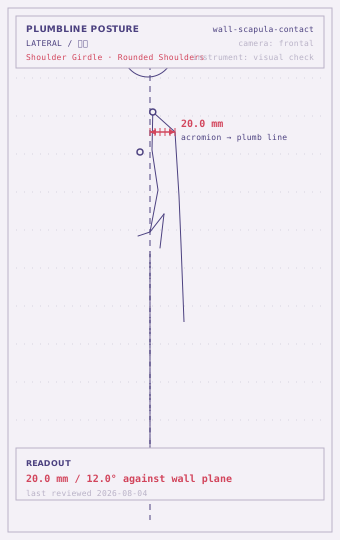
Within range
0-10 mmCriterion: Both scapulae hold wall contact with a light effort, and neither blade lifts when the arms are raised to shoulder height and lowered again.
The blades have a resting position near the rib cage and can be brought back to it with a small effort. This is the reference the other screens at this station are read against.
Borderline
11-25 mmCriterion: One or both blades lift 11 to 25 mm off the wall at rest, close on cue, and lift again within a minute of releasing.
Correctable but not retained, one side more than the other in most people. Record which side and re-check in four weeks.
Deviated
over 25 mmCriterion: More than 25 mm of lift that does not close on cue, or a visible gap between the medial border of the blade and the rib cage, or the blade lifts further when the arm is raised.
A blade that cannot be brought back at all is a different finding from one that drifts. Screen the shoulder's elevation before treating this as a posture reading.
| Tier | What to do |
|---|---|
| Low | Reading sits in the within-range band and is symmetric side to side: re-measure every 8–12 weeks and record which way the number is moving. |
| Moderate | Reading sits in the borderline band, or the two sides differ clearly: re-measure every 4–6 weeks and log the daily trigger (hours seated, one-sided load). Change the situation before adding anything to the routine. |
| High | Reading sits in the deviated band, or several screens at the same station all read deviated: get a clinician to rule out a structural or neural cause before continuing to self-screen. |
| Referral threshold | A shoulder that will not elevate, a painful arc between 60 and 120 degrees, or a step where the deltoid meets the arm needs a clinician. |
Commonly co-occurring
How to read this
Contact, not position
Most rounded-shoulder descriptions talk about position: how far forward the shoulder sits relative to a vertical line. This screen reads something coarser and more robust — whether the shoulder blade can touch the rib cage at all, and whether it stays there.
That is a binary question with a distance attached to it, and it is far less sensitive to camera placement and body shape than an angle. It is also the reading that most directly translates into what a person can feel: the moment the blade loses contact is usually the moment the shoulder starts to ache.
Running it
Stand with the back to a bare wall, heels about 150 mm out so the body is not propped against it. Bring the head and the sacrum lightly to the wall. Then, without shrugging, draw the shoulder blades gently back toward the wall and hold for a slow count of five.
Count how many blades make contact. Then release completely and count again — most people keep contact for a few seconds and then lose one side. Note which side goes first. Repeat three times.
Reading the two sides
The asymmetry is the useful part. If both blades hold contact, the answer to this screen is finished. If one holds and one does not, the reading describes a shoulder that is being carried differently from its neighbour — which has a cause in how the day is spent, usually a bag, a mouse, or an arm that is always doing the same job.
A blade that cannot be brought back at all, on the other hand, is not a posture reading. Screen the shoulder’s elevation range first; if the arm cannot be raised normally, the blade position is a consequence and belongs to a clinician.
Why this reading is not an angle
Angles are attractive because they feel precise. On a shoulder they are also fragile: a few degrees of camera rotation, a loose shirt, or a slightly different standing width move the number more than a month of habit does. Contact distances in millimetres are cruder but survive all three of those errors, which is why this is the screen written for repeat measurement.
Questions
Should my head touch the wall?
Lightly, yes — it gives you a reference for the thoracic position. If the back of the head will not reach the wall without lifting the chin, note that separately; it is the finding the supine occiput screen measures.
How hard should I press?
Lightly. Pressing hard recruits the rhomboids and lower trapezius and can produce contact that the shoulder does not hold in ordinary standing. The useful reading is the one produced by the smallest effort that makes contact at all.
Is it normal for one side to be worse?
Almost universal. Handedness, a shoulder bag, a mouse arm and a racket all make one side different from the other. Record both sides separately; the difference between them is usually more informative than either value alone.
Disclaimer
This page is informational only. It is not a medical diagnosis and it is not treatment or rehabilitation advice. Run every self-screen inside a pain-free range; stop and see a clinician for pain, numbness, weakness, night pain, or anything that started after an injury. The readout criteria are drawn from healthy-adult norms — prior injury, surgery and individual variation all shift the numbers.
lastReviewed 2026-08-04 · record wall-scapula-contact · published 2026-08-15