- Home
- Head and Neck
- Forward Head
- Wall Tragus Line Test
Wall Tragus Line Test
The simplest forward-head screen there is: a wall, a ruler, and the distance from the tragus to a vertical line. Two readings decide it — the resting gap and whether the gap closes on cue.
- Gear
- A bare wall, a doorway edge or a plumb bob hung from a door frame, and a ruler.
- Stance
- Stand with the heels about 75 mm from the wall, weight even, looking straight ahead. Do not lean back onto the wall.
- Duration
- 60 s
- Camera angle
- lateral, lens level with the landmark
- Position
- The wall supplies the vertical reference. Stand side-on to a partner or a mirror so the tragus and the C7 spine can both be seen at once, and hold the first reading for 60 seconds without correcting.
Bone landmarks
-
Tragus — coordinate id
tragus -
C7 spinous process — coordinate id
c7 -
Acromion — coordinate id
acromion
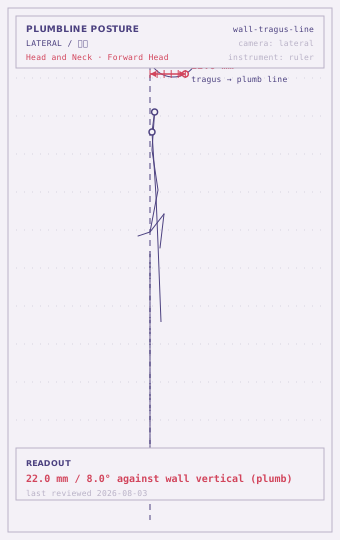
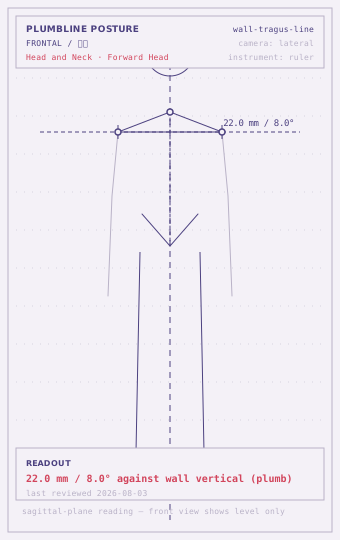
Within range
0-15 mmCriterion: The tragus sits 0 to 15 mm forward of the wall line, and the gap closes to 5 mm or less when the person is asked to sit tall.
A head that can be brought back over the shoulders on request is a habitual position, not a fixed one. Record the number and re-measure in three months.
Borderline
16-30 mmCriterion: The tragus sits 16 to 30 mm forward, and the gap partly closes on cue but drifts back out within two minutes of holding the corrected position.
The ability to correct is present but not sustainable, which is the reading that separates a long day at a screen from a position the body has started to treat as neutral.
Deviated
over 30 mmCriterion: The tragus sits more than 30 mm forward at rest, does not change when the person is asked to sit tall, or the ear-to-shoulder line visibly breaks when viewed from the side.
A reading that does not respond to a cue is the point at which the number stops being about habit. Screen the neck for range and any neural signs before recording it as a posture finding.
| Tier | What to do |
|---|---|
| Low | Reading sits in the within-range band and is symmetric side to side: re-measure every 8–12 weeks and record which way the number is moving. |
| Moderate | Reading sits in the borderline band, or the two sides differ clearly: re-measure every 4–6 weeks and log the daily trigger (hours seated, one-sided load). Change the situation before adding anything to the routine. |
| High | Reading sits in the deviated band, or several screens at the same station all read deviated: get a clinician to rule out a structural or neural cause before continuing to self-screen. |
| Referral threshold | Stop and see a clinician if the forward head comes with arm pain, numbness or tingling in the hand, night pain that wakes you, or a stiff neck with fever. |
Red flag Radiating pain into the arm, numbness or tingling in the hand, night pain that wakes you, or a stiff neck with fever are outside self-screening. Book a clinician rather than repeating the measurement.
Commonly co-occurring
How to read this
What the test actually measures
Two numbers, and both of them matter more than the first alone.
The first is the resting gap: how far the tragus sits forward of a true vertical dropped through the shoulder. That tells you where the head is being carried when nobody is watching.
The second is the cued gap: the same measurement taken after you have been asked to sit tall. The difference between the two is the useful part. A 25 mm resting gap that closes to 4 mm on cue and stays there is a habit. The same 25 mm that closes to 20 mm, or closes and then drifts back within two minutes, is a position the body is defending.
Running it
Set the plumb line up so it passes through the shoulder, or stand against a wall edge with the heels around 75 mm out. Have a partner read the horizontal distance from the line to the tragus — the small flap of cartilage in front of the ear canal, not the earlobe and not the jaw angle.
Take the resting reading first, before you have thought about your posture at all. Then take the cued reading. Then hold the corrected position and take a third reading two minutes later. Write all three down.
Common measurement errors
- Reading to the earlobe. The earlobe hangs on the neck, not the skull, and moves with it. The tragus is fixed to the temporal bone and is the landmark that belongs in this test.
- Leaning the upper back against the wall. That changes the shoulder position and makes the head look more forward than it is.
- Correcting while the first reading is taken. The first reading must be the unthinking one, or the test measures nothing.
- Measuring after exercise. Warm tissue changes the resting position for an hour or more.
What to do with the number
This test does not tell you what to do. It tells you whether the thing you would do is worth doing, and later, whether it worked. If the resting gap is in the within-range band and the cued reading matches it, the reading is finished — write the date and re-measure in about three months.
If the gap is in the borderline band, the reading to work on is the two-minute one. Record it, change one thing about how the screen is set up, and re-measure in four weeks. A gap that holds at the corrected value after two minutes is the outcome the test is built to detect.
Only when the resting gap is over 30 mm and does not move on cue does the number stop being about habit. At that point, screen the neck’s rotation and side-bend range first, note any neural signs, and treat it as a finding to be assessed rather than a position to be corrected.
Questions
Should I measure with shoes on or off?
Off. A heel changes the height of the whole chain and shifts the shoulder position the head is being read against. Measure barefoot, on a hard floor, with the feet in their usual stance width.
My mirror gives a different number from my partner. Which is right?
Neither is more right — they are different references. A plumb bob hung from a door frame is a true vertical, while a mirror asks you to judge vertical by eye. Use the bob when you can, and stay with one method for repeat measurements, because a change between methods is indistinguishable from a change in the reading.
How hard should I try when asked to sit tall?
Gently. The corrected reading is meant to show whether the position is reversible, not how far you can force it. Pulling the chin back hard recruits different muscles and can add several millimetres that do not represent an easy standing position.
Disclaimer
This page is informational only. It is not a medical diagnosis and it is not treatment or rehabilitation advice. Run every self-screen inside a pain-free range; stop and see a clinician for pain, numbness, weakness, night pain, or anything that started after an injury. The readout criteria are drawn from healthy-adult norms — prior injury, surgery and individual variation all shift the numbers.
lastReviewed 2026-08-03 · record wall-tragus-line · published 2026-08-12