- Home
- Head and Neck
- Forward Head
- Doorframe Occiput Drop
Doorframe Occiput Drop
A pencil, a door frame and 45 seconds. Mark where the back of the head touches, let the head settle, mark again, and measure the drift between the marks.
- Gear
- A door frame with a square head jamb, a pencil, and a tape measure.
- Stance
- Stand in the frame with the back of the head lightly touching the jamb, chin level, arms relaxed at the sides.
- Duration
- 45 s
- Camera angle
- lateral, lens level with the landmark
- Position
- Mark where the occiput touches, then let the head return to its resting position and mark again. The distance between the two pencil marks is the reading.
Bone landmarks
-
Occiput — coordinate id
occiput -
C7 spinous process — coordinate id
c7 -
Tragus — coordinate id
tragus
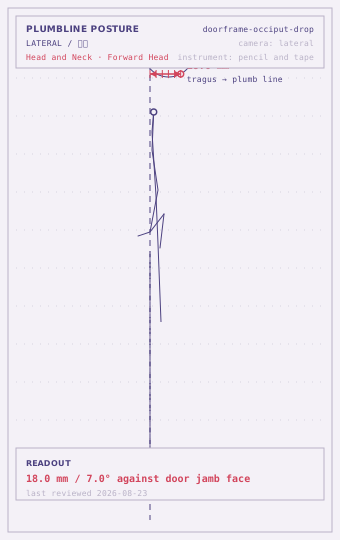
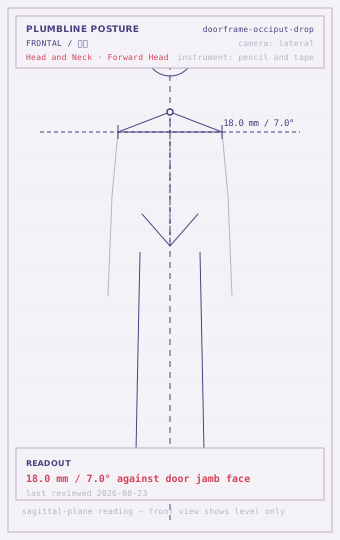
Within range
0-12 mmCriterion: The occiput returns to the jamb within 12 mm of the touched position and stays there for the 45-second hold.
The head has a resting position close to the vertical, and the neck can hold it there without effort.
Borderline
13-25 mmCriterion: The occiput drifts 13 to 25 mm off the jamb at rest, or reaches the jamb on cue but drifts away again before the hold ends.
Correctable but not holdable. This is the band where changing the workstation layout usually moves the number more than any exercise would.
Deviated
over 25 mmCriterion: More than 25 mm of drift at rest, or the occiput cannot be brought to the jamb at all without lifting the chin or extending the upper neck.
When reaching the reference requires a different compensation, the reading is no longer about where the head rests but about how far the neck can move. Measure the range first.
| Tier | What to do |
|---|---|
| Low | Reading sits in the within-range band and is symmetric side to side: re-measure every 8–12 weeks and record which way the number is moving. |
| Moderate | Reading sits in the borderline band, or the two sides differ clearly: re-measure every 4–6 weeks and log the daily trigger (hours seated, one-sided load). Change the situation before adding anything to the routine. |
| High | Reading sits in the deviated band, or several screens at the same station all read deviated: get a clinician to rule out a structural or neural cause before continuing to self-screen. |
| Referral threshold | A clinician, not a self-test, is needed if the drift comes with dizziness on head movement, a feeling that the room is spinning, or any loss of balance. |
Commonly co-occurring
How to read this
Why a door frame
The door frame does one thing that a mirror cannot: it gives a fixed physical reference that does not depend on your judgement of vertical. You do not have to decide where straight is. You either touch the jamb or you do not.
That makes this the most repeatable of the head-position screens, and the one least sensitive to who is doing the measuring. The cost is that it only reads one direction — how far the head sits behind the plane of the jamb, not how it sits in relation to the shoulders.
The procedure
Stand in the frame, heels about 75 mm forward of the jamb so the body is not leaning into it, and bring the back of the head lightly to the wood. Note the contact point, then step away for a moment and let the head return to whatever position it takes without instruction. Step back in and mark where the occiput is now. The distance between the first and second marks is the reading.
Then do the cued version: bring the head back to the jamb and hold it there for 45 seconds. Mark again at the end. Whether the head stays on the jamb or drifts off it during the hold is the second half of the test, and it is the half that distinguishes a position you can take from a position you can keep.
Reporting it
Write down three numbers: resting drift, cued drift, and the drift at the end of the 45-second hold. A record that says only “forward head” is not a measurement. A record that says “18 mm resting, 2 mm cued, 19 mm after 45 seconds” tells you the correction does not survive, which is a different problem from a head that cannot be corrected at all.
Limits
This test reads the head against a wall, not against the spine. It cannot tell you whether a forward head comes from the upper neck, the lower neck, or from a thoracic curve that the head is compensating for. For that you need a side photograph with the shoulder and the hip in frame, which is what the photographic screens at this station are for.
It is also blind to rotation. A head that is carried forward and turned is a different reading from one carried straight forward, and the door frame will not show the difference.
Questions
How much of the head should touch the jamb?
The most prominent point of the occiput, lightly — contact, not pressure. Pressing the head back into the frame recruits the neck extensors and flattens the natural curve, which changes the resting mark.
My door frame has a rounded head jamb. Does that matter?
It changes the reference, not the logic. A rounded jamb gives a contact point whose position depends on how hard you press, so the marks drift between sessions. Use a flat jamb if you have one; if not, keep the same light contact every time and treat the numbers as comparable only to themselves.
Disclaimer
This page is informational only. It is not a medical diagnosis and it is not treatment or rehabilitation advice. Run every self-screen inside a pain-free range; stop and see a clinician for pain, numbness, weakness, night pain, or anything that started after an injury. The readout criteria are drawn from healthy-adult norms — prior injury, surgery and individual variation all shift the numbers.
lastReviewed 2026-08-23 · record doorframe-occiput-drop · published 2026-08-30