- Home
- Head and Neck
- Forward Head
- Seated Head Drift Timer
Seated Head Drift Timer
Sit at your own desk, work normally, and time how long it takes for the head to drift forward of the shoulder line. This screen measures the position you did not choose.
- Gear
- Your usual desk, a wall behind you or a phone set to record from the side, and a timer.
- Stance
- Sit as you normally sit at this desk. Do not set yourself up for the test — the point is to catch the position you drift into, not the one you can produce on request.
- Duration
- 600 s
- Camera angle
- lateral, lens level with the landmark
- Position
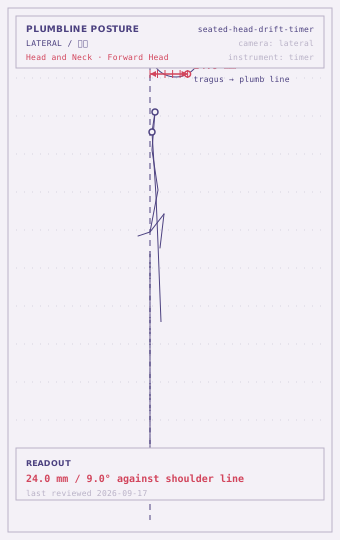
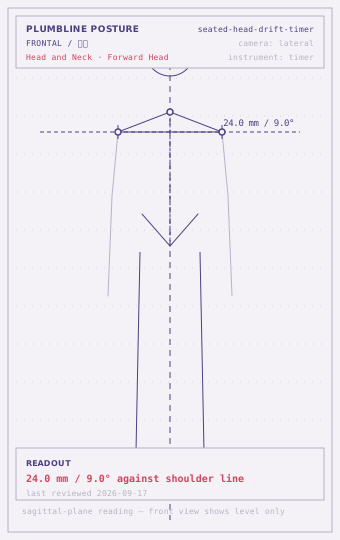
- Settle into ordinary work and note the moment the head starts to move forward of the shoulder line, then how long it takes to reach its furthest position. Repeat on three separate days.
Bone landmarks
-
Tragus — coordinate id
tragus -
C7 spinous process — coordinate id
c7 -
Acromion — coordinate id
acromion
Within range
over 45 minCriterion: The head stays behind the shoulder line for more than 45 minutes of ordinary work before drifting, and returns when the task changes.
The position is stable across a normal work block. Re-check when the desk or the screen changes.
Borderline
15-45 minCriterion: Drift begins between 15 and 45 minutes, or the head returns only when the person consciously corrects it.
The position is task-dependent rather than habitual. This is the band where taking breaks changes the reading and adding exercises does not.
Deviated
under 15 minCriterion: Drift begins within 15 minutes, or the head does not return to the shoulder line at any point during the work block.
When the drift starts immediately and never reverses, the desk setup is producing the position rather than the person's habits. Measure the screen height and the chair before reading this as a neck problem.
| Tier | What to do |
|---|---|
| Low | Reading sits in the within-range band and is symmetric side to side: re-measure every 8–12 weeks and record which way the number is moving. |
| Moderate | Reading sits in the borderline band, or the two sides differ clearly: re-measure every 4–6 weeks and log the daily trigger (hours seated, one-sided load). Change the situation before adding anything to the routine. |
| High | Reading sits in the deviated band, or several screens at the same station all read deviated: get a clinician to rule out a structural or neural cause before continuing to self-screen. |
| Referral threshold | Progressive neck stiffness that does not ease with movement, or any neck symptom with arm pain, should be assessed. |
Commonly co-occurring
How to read this
Measuring the position you did not choose
Every screen that asks you to stand, sit or lie in a specified way answers the question “what can this body do”. This one answers a different question: “what does this body do when nobody is asking”. Both matter, and they disagree more often than people expect.
The test runs during work, not instead of it. You sit down, do your job, and note two moments: when the head crosses forward of the shoulder line, and when it stops moving.
Running it
Sit as usual. If you want an objective record, prop the phone to the side with the shoulder and the ear both in frame and let it record; a forty-minute clip is enough. Otherwise, check in every few minutes and note the clock when the chin starts to lead.
Write down three numbers for each session: the time drift started, the time it reached its furthest point, and whether it returned on its own when the task changed. The third one is the one that distinguishes a position that is being held from one that is simply not being noticed.
Repeat on three separate days, ideally with similar work. The recurring number is the reading; a single bad afternoon is not.
What the number is actually good for
Drift time is the most actionable number at this station, because it responds to the room rather than to the person. If drift starts at eight minutes with the screen low and at thirty-five minutes with the screen raised, the intervention that works is already identified and it costs nothing to apply.
That is also why the test should be repeated after any change to the desk. A drift time measured before and after the rearrangement is the only evidence that the rearrangement did anything, and it is far more informative than a photograph taken at the end of a long day.
Limits
Drift time cannot be compared between two people: the tasks are different, the chairs are different, and the definition of “started to drift” is a judgement call. Compare it only against your own previous reading, taken the same way, on similar work.
Questions
How do I know when the drift starts?
By feel at first: there is a moment when the back of the neck goes quiet and the chin begins to lead. If you want it objective, record from the side with the phone and check the frames afterwards — the shoulder and the ear are both visible, so the crossing point is easy to spot.
Three days seems like a lot of measurement for one number.
One day gives you the drift time for that day's task, not for your neck. Working on a spreadsheet, a video call and a document produce different times, and the useful number is the one that recurs. Three days is the minimum to tell a pattern from a bad afternoon.
Should I correct during the test?
No. Correcting is what you already do all day, and it is not the thing being measured. The measurement is the unmanaged drift time; the managed version is what the chin tuck release screen reads.
Disclaimer
This page is informational only. It is not a medical diagnosis and it is not treatment or rehabilitation advice. Run every self-screen inside a pain-free range; stop and see a clinician for pain, numbness, weakness, night pain, or anything that started after an injury. The readout criteria are drawn from healthy-adult norms — prior injury, surgery and individual variation all shift the numbers.
lastReviewed 2026-09-17 · record seated-head-drift-timer · published 2026-09-28