- Home
- Head and Neck
- Forward Head
- Chin Tuck Release Check
Chin Tuck Release Check
Correct the head position, hold it, release, and time how long it survives. This screen measures the release, not the tuck — how long the correction lasts without supervision.
- Gear
- A wall or a mirror, and a clock or phone timer with a visible second hand.
- Stance
- Sit or stand tall without forcing, arms down, gaze level. This screen is about what happens after a correction, not about how far the correction goes.
- Duration
- 120 s
- Camera angle
- lateral, lens level with the landmark
- Position
- Retract the chin gently, hold for ten slow seconds, release, and watch how long the position lasts before the head drifts back. Repeat twice and take the average.
Bone landmarks
-
Tragus — coordinate id
tragus -
C7 spinous process — coordinate id
c7 -
Occiput — coordinate id
occiput
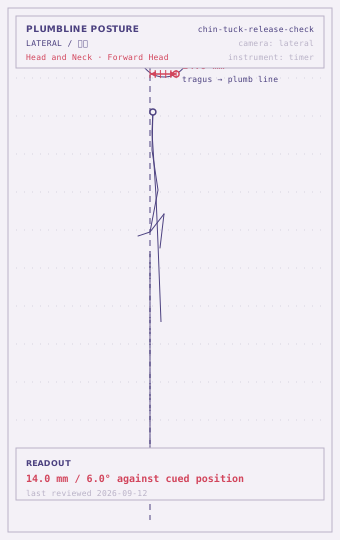
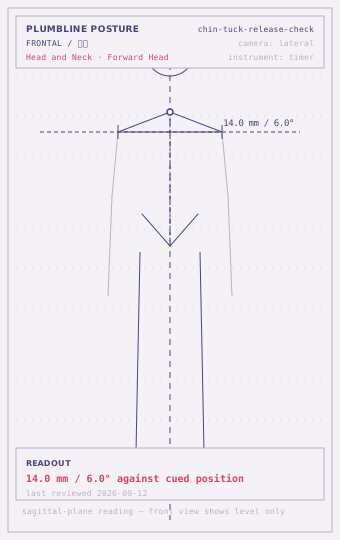
Within range
over 120 sCriterion: The corrected position survives more than two minutes of ordinary activity without being re-set by conscious effort.
The neck can hold the head over the shoulders without supervision. Re-check at the next seasonal change of workstation.
Borderline
30-120 sCriterion: The position holds for between 30 and 120 seconds before drifting more than a third of the way back to the resting gap.
The correction is available and quickly lost. This is the band where a change to the furniture or the screen height moves the number most reliably.
Deviated
under 30 sCriterion: The position cannot be held for 30 seconds, or the attempt produces a tremor, a breath hold, or a pulling sensation at the skull base.
When holding the position is effortful rather than merely brief, the limiting factor is the muscles that hold it, not the habit. Measure the hold capacity before reading this as a posture finding.
| Tier | What to do |
|---|---|
| Low | Reading sits in the within-range band and is symmetric side to side: re-measure every 8–12 weeks and record which way the number is moving. |
| Moderate | Reading sits in the borderline band, or the two sides differ clearly: re-measure every 4–6 weeks and log the daily trigger (hours seated, one-sided load). Change the situation before adding anything to the routine. |
| High | Reading sits in the deviated band, or several screens at the same station all read deviated: get a clinician to rule out a structural or neural cause before continuing to self-screen. |
| Referral threshold | A clinician should look at any neck position that is held with visible effort, tremor, or that comes with a feeling of instability. |
Commonly co-occurring
How to read this
The measurement is the release
Almost every forward-head screen measures how far the head is out of position. This one measures something different: what happens after you put it back. The distinction matters because the two are frequently unrelated. A head can sit 35 mm forward and hold a corrected position for five minutes; a head can sit 12 mm forward and lose the position in fifteen seconds.
The second pattern is the one that responds to a change in setup rather than to any kind of training, and it is the one this screen is built to find.
Procedure
Sit or stand as you normally would, then retract the chin gently — a nod of agreement, not a military brace — until the ear is roughly over the shoulder. Hold for ten slow seconds to confirm you can find the position reliably, then release. Start the timer at the moment of release.
Watch what happens without intervening. The head will hold for a while and then drift back toward where it was. Stop the clock when it has covered about a third of the distance back to the resting gap. Repeat three times and use the middle value.
Reading it
Under 30 seconds usually means the position is being held by effort rather than by the postural system, and the limiting factor is holding capacity rather than habit. Between 30 and 120 seconds is where a workstation change does the most work: the neck can hold the position, but the position it is being asked to hold is fighting the furniture. Over two minutes and the screen has told you all it can.
Why the release matters more than the tuck
Most advice about forward head assumes that if you correct often enough, the correction will stick. That assumes the two things — reach and hold — are the same capacity. They are not. Reach is a range-of-motion question, and most people with a forward head can reach the corrected position easily. Hold is a question about which muscles are doing the work by default, and it is not improved by correcting more times per day.
Timing the release tells you which of the two you are dealing with, and only one of them is improved by changing the room you sit in.
Questions
How far should I retract?
Until the head is over the shoulders, not as far as it will go. The end-range position recruits different muscles and is not the position the neck would hold in ordinary activity, which makes it the wrong thing to time.
Is a longer hold always better?
For this test, yes, up to about two minutes; beyond that the recording stops telling you anything new, because ordinary activity involves movement rather than a static hold. The point is that the position should not need to be re-set by conscious effort every few seconds.
Should I time it in sitting or standing?
In whichever position your working day is spent in. Sitting and standing load the neck differently, and a hold time measured standing does not transfer to a desk.
Disclaimer
This page is informational only. It is not a medical diagnosis and it is not treatment or rehabilitation advice. Run every self-screen inside a pain-free range; stop and see a clinician for pain, numbness, weakness, night pain, or anything that started after an injury. The readout criteria are drawn from healthy-adult norms — prior injury, surgery and individual variation all shift the numbers.
lastReviewed 2026-09-12 · record chin-tuck-release-check · published 2026-09-22