- Home
- Head and Neck
- Forward Head
- Deep Neck Flexor Hold Test
Deep Neck Flexor Hold Test
A light nod, held on the back, timed until the chin lifts. It measures holding capacity rather than range, and the way the hold fails is the useful part.
- Gear
- A firm flat surface, a folded towel, and a timer.
- Stance
- Lie on the back with the knees bent, head in a light nod position — as if agreeing slowly — with the back of the neck long, not pressed down.
- Duration
- 120 s
- Camera angle
- lateral, lens level with the landmark
- Position
- Hold the light nod and time how long it can be maintained while breathing normally and without the chin lifting. Stop when the chin starts to lift or the head shakes.
Bone landmarks
-
Occiput — coordinate id
occiput -
C7 spinous process — coordinate id
c7 -
Tragus — coordinate id
tragus
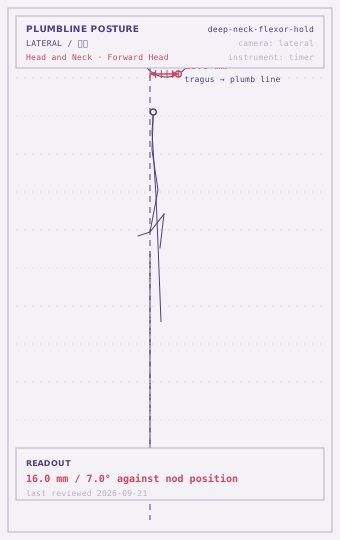
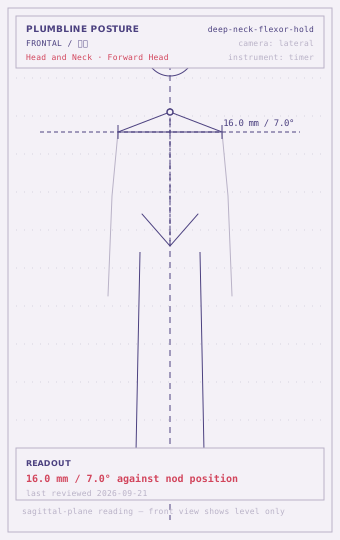
Within range
over 30 sCriterion: The light nod is held for more than 30 seconds with the chin staying level and the breathing unchanged.
The deep neck flexors can hold the head's weight. Holding capacity is not the limiting factor in whatever the forward head is doing.
Borderline
10-30 sCriterion: Between 10 and 30 seconds, or the chin gradually lifts as the hold proceeds even though the person believes the position is unchanged.
The hold fails by substitution rather than by fatigue — the superficial muscles take over and the chin rises. This is the pattern that responds to a change in the daily position, not to more holding practice.
Deviated
under 10 sCriterion: Under 10 seconds, or the head shakes, or the breath is held, or the back of the neck is pressed hard into the surface to keep the chin down.
Pressing the back of the neck down substitutes the neck extensors for the flexors, which invalidates the hold. Re-learn the light nod on a rolled towel before timing it again.
| Tier | What to do |
|---|---|
| Low | Reading sits in the within-range band and is symmetric side to side: re-measure every 8–12 weeks and record which way the number is moving. |
| Moderate | Reading sits in the borderline band, or the two sides differ clearly: re-measure every 4–6 weeks and log the daily trigger (hours seated, one-sided load). Change the situation before adding anything to the routine. |
| High | Reading sits in the deviated band, or several screens at the same station all read deviated: get a clinician to rule out a structural or neural cause before continuing to self-screen. |
| Referral threshold | Neck pain with a feeling that the head is too heavy to hold up, or with any arm symptom, is a clinical question rather than a holding-capacity question. |
Commonly co-occurring
How to read this
Capacity, not range
This is the one screen at this station that measures a muscle group rather than a position, and it is here because a forward head is not only a geometry problem. The muscles that hold the head over the shoulders are the deep neck flexors, and their job is a holding job: small position, long duration, low load.
Holding tasks are not trained by moving further. They are lost by not being used, and the way to find out whether that has happened is to ask for a long, small effort and watch what gives way first.
Procedure
Lie on your back with the knees bent, and find the light nod: draw the chin very slightly toward the throat, as if agreeing slowly, until the back of the neck feels long rather than compressed. Hold it and start the clock.
Breathe normally. A hold that requires a breath hold is a hold that has already failed. Watch the chin: as the deep muscles give out, the superficial ones take over and the chin starts to rise. Stop the clock when the chin lifts, the head shakes, or the back of the neck starts pressing into the surface.
Reading the failure
The number matters less than the mode. A clean 20-second hold that ends because the position gradually runs out is a different finding from a 20-second hold in which the chin creeps up from the fifth second onwards. The first is capacity; the second is substitution, and substitution is what a long day at a screen produces.
Substitution is not fixed by practising the hold. It is fixed — or at least moved — by changing the position the neck spends its day in, so that the deep muscles are used by default rather than only during a test.
Where this screen stops
A hold time is not a pain measure and does not predict who will develop neck pain. It is a single capacity reading that belongs in a series, taken the same way each time, alongside the head-position screens. When it is low and the position screens are also out of range, the two together point at the daily position rather than at the neck itself.
Questions
How hard should I nod?
About as much as a slow nod of agreement — a few millimetres of chin movement, no more. If you can see your own chin in your peripheral vision, it is too far. The test is about holding a small position for a long time, not a large one for a short time.
Why does the way the hold fails matter?
Because there are two different failure modes. One is fatigue: the position is held correctly and simply runs out. The other is substitution: the chin gradually rises and the superficial muscles take over while the person believes nothing has changed. The second pattern is common in people who sit with the head forward all day, and it is the one that responds to changing the daily position.
Can I do this sitting against a wall?
You can, but the reference is worse. Lying down removes gravity from the equation and makes it much easier to feel whether the nod is being produced by the deep muscles or by pressing the head down. Start on the floor and use a wall version only for quick re-checks.
Disclaimer
This page is informational only. It is not a medical diagnosis and it is not treatment or rehabilitation advice. Run every self-screen inside a pain-free range; stop and see a clinician for pain, numbness, weakness, night pain, or anything that started after an injury. The readout criteria are drawn from healthy-adult norms — prior injury, surgery and individual variation all shift the numbers.
lastReviewed 2026-09-21 · record deep-neck-flexor-hold · published 2026-09-26