- Home
- Head and Neck
- Forward Head
- Supine Occiput Gap
Supine Occiput Gap
Lie flat and measure the space under the back of the skull. It removes gravity from the equation and reads the neck's resting position with nothing to hold up.
- Gear
- A firm flat surface, a folded towel, and a tape measure.
- Stance
- Lie on the back with the legs straight and the arms at the sides, head in its natural resting position on the surface. Do not tuck the chin.
- Duration
- 60 s
- Camera angle
- lateral, lens level with the landmark
- Position
- Measure the vertical gap between the highest point of the occiput and the surface. Then place the towel under the head and re-measure.
Bone landmarks
-
Occiput — coordinate id
occiput -
C7 spinous process — coordinate id
c7 -
Vertex — coordinate id
vertex
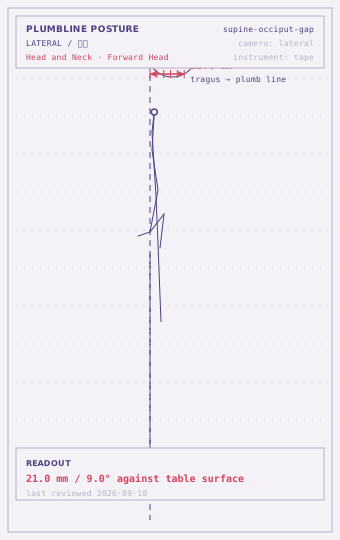
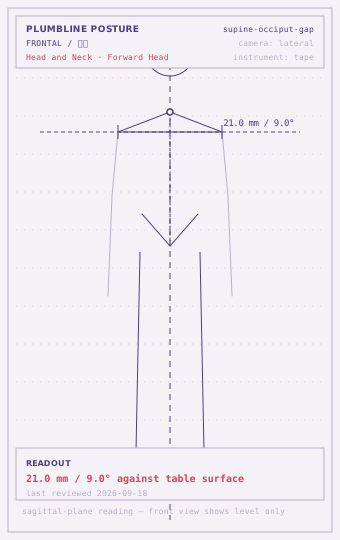
Within range
0-10 mmCriterion: The occiput rests within 10 mm of the surface, and the chin is level rather than lifted when the head is fully supported.
The head rests on the skull rather than on the neck. Nothing to record beyond the date.
Borderline
11-25 mmCriterion: A gap of 11 to 25 mm that closes when a folded towel is placed under the head, and the chin level improves with it.
The resting position is extended, and the correction is a support rather than a movement. Log the towel thickness that closes the gap.
Deviated
over 25 mmCriterion: More than 25 mm of gap, or the chin stays lifted after support is added, or lying flat produces arm or hand symptoms.
A large gap that survives support usually belongs to the thoracic spine rather than the neck. It also makes lying flat a provocative position, which is a clinical question rather than a postural one.
| Tier | What to do |
|---|---|
| Low | Reading sits in the within-range band and is symmetric side to side: re-measure every 8–12 weeks and record which way the number is moving. |
| Moderate | Reading sits in the borderline band, or the two sides differ clearly: re-measure every 4–6 weeks and log the daily trigger (hours seated, one-sided load). Change the situation before adding anything to the routine. |
| High | Reading sits in the deviated band, or several screens at the same station all read deviated: get a clinician to rule out a structural or neural cause before continuing to self-screen. |
| Referral threshold | Lying flat that brings on arm pain, hand numbness, or a feeling the neck cannot support the head needs a clinician, not a pillow adjustment. |
Red flag Lying flat that produces arm pain, hand numbness, or a sense that the neck cannot support the head needs a clinician rather than a pillow change.
Commonly co-occurring
How to read this
Gravity off
Every other screen at this station reads the head against a vertical, with the neck working. This one takes the working out of it. Lying flat, the head is supported by whatever is under it, and the gap between the occiput and the surface is a direct read of how much extension the neck is holding at rest.
That is a different question from how far the head is carried forward when standing, and the two do not move together. A person can have a clear forward head standing and a flat occiput lying down, and the reverse turns up just as often.
Procedure
Lie on a firm surface, legs straight, arms at the sides, and let the head settle. Do not tuck the chin and do not stretch the neck. Measure the vertical gap between the highest point of the occiput and the surface at the point of contact.
Then fold a towel to about 20 mm, place it under the head, and measure again. Record both numbers and note whether the chin came down to level with the towel in place. If the lower back objects to straight legs, repeat with the knees bent over a pillow and label both readings.
What the two numbers mean together
The bare gap is the resting position. The supported gap is the correction. When the supported reading is near zero and the chin levels, the neck’s default is extension and the fix is a pillow, not a movement. When the supported reading stays large, the extension is being driven by the thoracic spine, and the head is not where the work is.
A note on pillows
The useful measurement here transfers directly to the bed. If a 20 mm towel closes the gap, a pillow that puts the head into roughly the same position does the same job overnight. Most pillows are too thick for side-sleepers as well as back-sleepers, and the common pattern — a thick pillow that also pushes the head forward at the front edge — reproduces exactly the position this screen is measuring.
Questions
Does it matter whether the legs are straight?
Yes. Straight legs flatten the lumbar curve and pull the pelvis into a slight posterior tilt, which changes the thoracic position and therefore the head. Repeat the measurement with the knees bent on a pillow as a second reading if your lower back is sensitive.
Why does a towel change anything?
Because a support changes the resting position without asking the muscles to do anything. If a folded towel closes the gap and levels the chin, the position is a support problem and a pillow change is the correction. If the gap survives the towel, the position is coming from further down.
Can I do this on a bed?
Only if the mattress is firm enough that the surface does not conform to the head. On a soft mattress the head sinks and the gap you measure is the mattress, not the neck. Use a floor or a firm table.
Disclaimer
This page is informational only. It is not a medical diagnosis and it is not treatment or rehabilitation advice. Run every self-screen inside a pain-free range; stop and see a clinician for pain, numbness, weakness, night pain, or anything that started after an injury. The readout criteria are drawn from healthy-adult norms — prior injury, surgery and individual variation all shift the numbers.
lastReviewed 2026-09-18 · record supine-occiput-gap · published 2026-09-24