- Home
- Shoulder Girdle
- Rounded Shoulders
- Doorway Hand-to-Wall Reach
Doorway Hand-to-Wall Reach
Arm at shoulder height, hand reaching back for the wall. The distance your middle finger misses it by is the reading, and the two sides rarely match.
- Gear
- A doorway or a clear wall section, and a ruler or tape measure.
- Stance
- Stand in the doorway with the arm raised to shoulder height and the elbow straight, palm facing down, back of the hand toward the frame.
- Duration
- 60 s
- Camera angle
- lateral, lens level with the landmark
- Position
- Reach the hand back toward the wall at shoulder height and measure the gap between the middle finger and the surface. Measure both sides and note the difference.
Bone landmarks
-
Acromion — coordinate id
acromion -
Mid-humerus — coordinate id
mid-humerus -
Scapular spine — coordinate id
scapular-spine
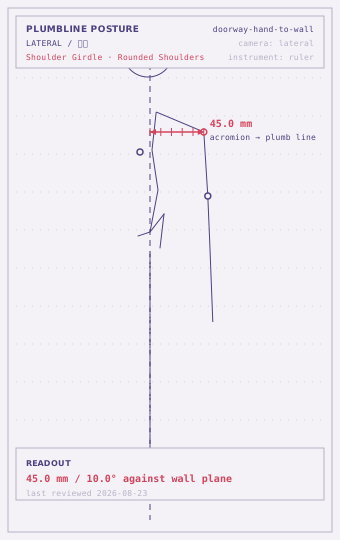
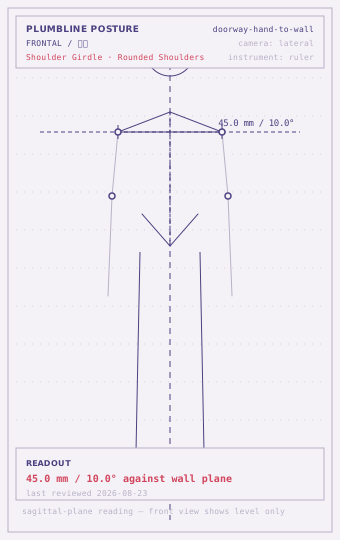
Within range
0-30 mmCriterion: The middle finger reaches within 30 mm of the wall on both sides, with the arm at shoulder height and the elbow straight.
The shoulder can be taken back through its full available range without the chest wall blocking it. Nothing to record beyond the date.
Borderline
31-80 mmCriterion: A gap of 31 to 80 mm, or a side-to-side difference of more than 25 mm with both hands reaching.
A shortened reach on one or both sides. The asymmetry is usually the more useful number: a difference that appeared recently points at something the arm has been doing.
Deviated
over 80 mmCriterion: More than 80 mm of gap, or the reach cannot be performed with the arm at shoulder height at all, or reaching produces pain in the front of the shoulder.
Pain on this movement, or a reach limited by something other than tightness, is a clinical presentation. The screen stops here.
| Tier | What to do |
|---|---|
| Low | Reading sits in the within-range band and is symmetric side to side: re-measure every 8–12 weeks and record which way the number is moving. |
| Moderate | Reading sits in the borderline band, or the two sides differ clearly: re-measure every 4–6 weeks and log the daily trigger (hours seated, one-sided load). Change the situation before adding anything to the routine. |
| High | Reading sits in the deviated band, or several screens at the same station all read deviated: get a clinician to rule out a structural or neural cause before continuing to self-screen. |
| Referral threshold | Pain in the front of the shoulder on this movement, or a reach that feels blocked rather than tight, needs assessment before it is stretched. |
Commonly co-occurring
How to read this
A length measurement borrowed for a position question
This screen does not measure where the shoulder sits; it measures how much room the front of the shoulder has. The two are related, but they are not the same, and conflating them is the main error people make with rounded-shoulder self-testing.
A tight chest wall will hold a shoulder forward. A shoulder held forward for long enough will also shorten the chest wall. The direction of that loop cannot be read from the reach alone, which is why this screen belongs beside the contact screen rather than instead of it.
Carrying it out
Stand in a doorway or facing a clear wall section. Raise the arm to shoulder height — level with the floor, not higher — straighten the elbow, and turn the palm down. Without rotating the torso or letting the shoulder blade lift, reach the hand back toward the wall.
Measure the gap between the tip of the middle finger and the surface. Do the same on the other side. Repeat twice per side and use the smaller gap of the two attempts, since the first attempt usually overshoots.
Reading it
The absolute gap matters less than three things: whether it changed since last time, whether the two sides differ, and whether the limit feels like tightness or like a block.
Tightness eases gradually as you push into it. A block stops abruptly, often with a pinch at the front of the shoulder, and pushing into a block is the one thing this screen warns against. If the limit is a block, stop measuring and get it looked at.
Why the two sides disagree
Almost nobody measures the same on both sides. Handedness accounts for a few millimetres; a shoulder bag, a racquet, a mouse, or sleeping always on one side accounts for a good deal more. The number worth tracking is the difference, because it moves when a habit changes and stays put when nothing does.
Questions
Shoulder height exactly, or as high as I can?
Exactly. The test is defined at shoulder height because that is where the position is most comparable between people and between sessions. Reaching at any other height measures a different thing and cannot be tracked.
Does it matter which way my palm faces?
Yes — it changes the reading by a wide margin. Palm down puts the shoulder in internal rotation and shortens the reach; palm up lengthens it. The measurement here is defined palm-down. Pick it, write it down, and never compare a palm-down number with a palm-up one.
My reach improved after stretching. Does that mean the posture changed?
It means one tissue's length changed, which is what stretching does. Whether the shoulder's resting position changed is a different question, and it is answered by the wall scapula contact screen rather than this one. Keep both readings.
Disclaimer
This page is informational only. It is not a medical diagnosis and it is not treatment or rehabilitation advice. Run every self-screen inside a pain-free range; stop and see a clinician for pain, numbness, weakness, night pain, or anything that started after an injury. The readout criteria are drawn from healthy-adult norms — prior injury, surgery and individual variation all shift the numbers.
lastReviewed 2026-08-23 · record doorway-hand-to-wall · published 2026-09-02