- Home
- Shoulder Girdle
- Rounded Shoulders
- Wall Slide at Shoulder Height
Wall Slide at Shoulder Height
Forearms on the wall, sliding up. The reading is how far the wrists get before a shoulder blade lifts or the lower back has to arch to help.
- Gear
- A bare wall, and a partner or phone camera at waist height.
- Stance
- Stand with the back to the wall, feet about 150 mm out, arms at the sides.
- Duration
- 90 s
- Camera angle
- frontal, lens level with the landmark
- Position
- Raise both arms to shoulder height, elbows bent, and slide the forearms up the wall as far as they will go while the lower back stays neutral. Note the highest point and whether either blade lifts.
Bone landmarks
-
Acromion — coordinate id
acromion -
Scapular spine — coordinate id
scapular-spine -
Mid-humerus — coordinate id
mid-humerus
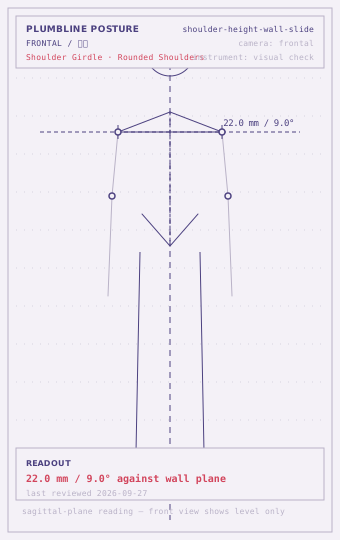
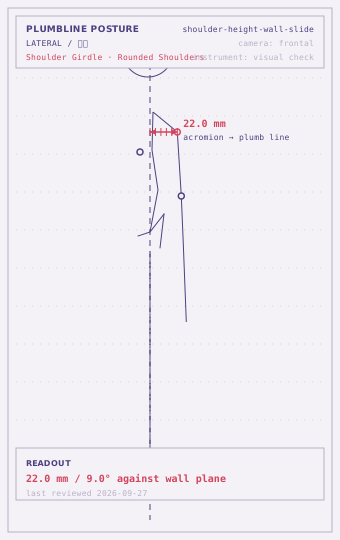
Within range
0-25 mmCriterion: The forearms slide up with the wrists reaching at least ear height, both blades holding wall contact, and no arching of the lower back.
The shoulder can move overhead without the rib cage having to change position. This is the reading to protect once achieved.
Borderline
25-60 mmCriterion: The slide stops between shoulder and ear height, or the blades hold contact only up to a point and then lift, or the lower back arches to gain height.
The restriction is in the shoulder complex rather than in the shoulder alone. Note how far the wrists reach, because that is the number that changes.
Deviated
over 60 mmCriterion: The slide cannot be taken above shoulder height, or one blade lifts immediately, or the movement produces pain or a pinching sensation.
A movement that cannot be started overhead is not a posture problem to work on at a desk. Screen elevation range with a clinician before continuing.
| Tier | What to do |
|---|---|
| Low | Reading sits in the within-range band and is symmetric side to side: re-measure every 8–12 weeks and record which way the number is moving. |
| Moderate | Reading sits in the borderline band, or the two sides differ clearly: re-measure every 4–6 weeks and log the daily trigger (hours seated, one-sided load). Change the situation before adding anything to the routine. |
| High | Reading sits in the deviated band, or several screens at the same station all read deviated: get a clinician to rule out a structural or neural cause before continuing to self-screen. |
| Referral threshold | A shoulder that will not go overhead, or that produces a painful arc during the movement, needs a clinician rather than a mobility programme. |
Commonly co-occurring
How to read this
A ceiling on shoulder movement
Reaching overhead is the movement the shoulder does least often in a desk life and the one that degrades fastest when it is not used. This screen measures it without asking for a lift: the forearms stay on the wall, and the wall sets the plane the arms have to travel in.
That makes the reading about the shoulder’s mechanics rather than about strength. A strong arm on a stiff shoulder will slide no further than a weak arm on a mobile one.
Procedure
Stand with the back to a bare wall, feet about 150 mm out, arms down. Bring the forearms to the wall at shoulder height with the elbows bent and the hands pointing up. Slowly slide the forearms upward, keeping contact, and stop at the first of three things: the wrists stop going up, a shoulder blade lifts off the wall, or the lower back arches.
Note where the wrists are at that point — below shoulder height, at shoulder height, between shoulder and ear, or at ear height. Repeat three times and record the best attempt.
Reading it
The height is the trackable number, but the stopping reason is the finding. Stopping because the shoulder runs out of range is a mobility reading. Stopping because the blade lifts or the back arches means the height reached was bought with compensation, and the real ceiling is lower than the mark suggests.
For a desk worker with a long-standing forward carriage, the common pattern is a slide that reaches ear height but with both blades off the wall for the last third of it. That pattern responds to changing the shoulder’s daily position, not to more sliding.
Stops
An overhead movement that produces a painful arc between roughly 60 and 120 degrees, or a shoulder that clicks hard at one point in every repetition, needs a clinician. This screen is for finding a ceiling, not for pushing through one.
Questions
Should I keep my lower back against the wall?
Keep it in a neutral position, not pressed flat. Pressing it flat changes the rib cage position and makes the shoulder look better or worse than it is. The warning sign is when the back arches to gain height — that is compensation, not range.
Elbows bent the whole way?
Bent, with the forearms in contact and the hands pointing up. Straightening the arms changes the movement into a different test and moves the reading by tens of degrees.
Is the height the wrist reaches the main number?
It is the number to track, yes — but the two things to watch for are a blade lifting and the lower back arching. Either of those means the height reached is not a shoulder measurement any more.
Disclaimer
This page is informational only. It is not a medical diagnosis and it is not treatment or rehabilitation advice. Run every self-screen inside a pain-free range; stop and see a clinician for pain, numbness, weakness, night pain, or anything that started after an injury. The readout criteria are drawn from healthy-adult norms — prior injury, surgery and individual variation all shift the numbers.
lastReviewed 2026-09-27 · record shoulder-height-wall-slide · published 2026-10-07