- Home
- Shoulder Girdle
- Rounded Shoulders
- Hand Behind Back Reach
Hand Behind Back Reach
One hand up the spine, measured from C7. It is a combined movement — extension, internal rotation and scapular glide — and the two sides almost never match.
- Gear
- A tape measure and a partner, or a wall mirror.
- Stance
- Stand tall, then take one hand behind the back and slide it up the spine as far as it goes without leaning or shrugging.
- Duration
- 60 s
- Camera angle
- frontal, lens level with the landmark
- Position
- Measure the vertical distance from the highest fingertip to the C7 spinous process. Repeat on the other side and record the difference.
Bone landmarks
-
Left acromion — coordinate id
acromion-l -
Right acromion — coordinate id
acromion-r -
Olecranon — coordinate id
elbow -
C7 spinous process — coordinate id
c7
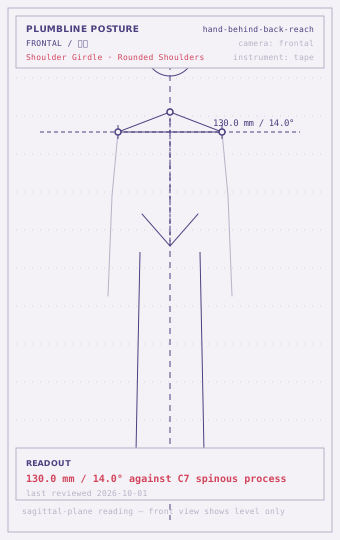
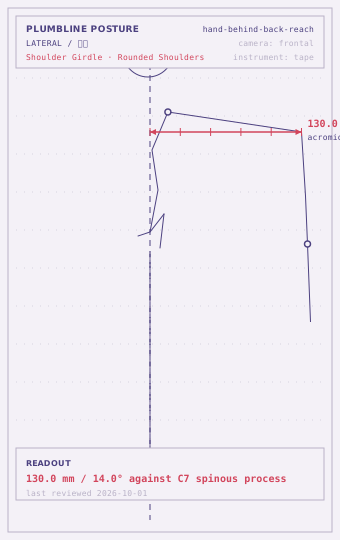
Within range
under 100 mmCriterion: The fingertips come within 100 mm of C7 on both sides, and the two sides differ by less than 40 mm.
Combined shoulder extension, internal rotation and scapular movement are all available. Nothing to record beyond the date.
Borderline
100-200 mmCriterion: A reach that stops 100 to 200 mm short, or a side-to-side difference between 40 and 80 mm.
A shortened combined movement. The difference between sides, if it is new, points at what the dominant arm has been doing.
Deviated
over 200 mmCriterion: More than 200 mm short on one or both sides, a difference over 80 mm, or the movement stops with a pinch or catch rather than a stretch.
A hard stop with a pinch is the pattern that must not be stretched. Have the shoulder examined before doing anything to it.
| Tier | What to do |
|---|---|
| Low | Reading sits in the within-range band and is symmetric side to side: re-measure every 8–12 weeks and record which way the number is moving. |
| Moderate | Reading sits in the borderline band, or the two sides differ clearly: re-measure every 4–6 weeks and log the daily trigger (hours seated, one-sided load). Change the situation before adding anything to the routine. |
| High | Reading sits in the deviated band, or several screens at the same station all read deviated: get a clinician to rule out a structural or neural cause before continuing to self-screen. |
| Referral threshold | A reach that ends in a sharp pinch, a shoulder that has lost rotation after an injury, or night pain in the shoulder needs a clinician before any stretching. |
Red flag A reach that ends in a sharp pinch, a shoulder that has lost rotation after an injury, or night pain in the shoulder should be examined before it is stretched.
Commonly co-occurring
How to read this
Three movements in one reading
Reaching up the spine is not a single shoulder movement. It requires the arm to extend behind the body, the humerus to rotate internally, and the shoulder blade to glide and tilt on the rib cage. Any one of the three being restricted produces the same result: the hand stops early.
That makes this a good screening movement and a poor diagnostic one. It tells you that something in the combination is limited. Which of the three it is requires testing each separately, and that is what the other screens at this station do.
Carrying it out
Stand upright, feet together, and take one hand behind the back. Slide the fingertips up the spine as far as they will go without leaning to the side, shrugging, or arching the lower back. Have a partner measure from the highest fingertip to the C7 spinous process with a tape, keeping the tape vertical.
Repeat on the other side. Record both numbers and the difference.
The difference is the reading
Absolute reach varies enormously with arm length, body proportions and age, so a single number is close to meaningless on its own. The difference between sides is stable and comparable: most people have 20 to 40 mm, and a difference over 80 mm is the point at which something one-sided is going on.
If the difference is new, look for a cause in the recent past — a change in how the arm is used, a night slept awkwardly, a new bag. If it is old and unchanged, it is a baseline, and the useful thing is the date attached to it.
When to stop
Stretching a combined movement that stops with a stretch is reasonable and often productive. Stretching one that stops with a pinch is not: a pinch usually means the shoulder is being driven into a position the joint does not have room for, and pushing further is how a restriction becomes an injury. If the movement ends in a sharp catch at the front of the shoulder, stop measuring and get the shoulder looked at.
Questions
Should I lean or shrug to get further?
No. Both add range that does not belong to the shoulder and make the two sides incomparable, since most people lean toward the side being tested. Stay upright, and if leaning is the only way to move, note it in the record.
Which point is C7 exactly?
The most prominent spinous process at the base of the neck when the head is nodded. Let the head drop forward and feel for the vertebra that stays put as the head moves; that one is C7 and it is the reference for both sides.
Is a side-to-side difference always a problem?
No, but a difference is more informative than either absolute number, and a difference that appeared recently is the most informative reading of all. Record both sides and the date so the next measurement can tell whether the gap is stable or growing.
Disclaimer
This page is informational only. It is not a medical diagnosis and it is not treatment or rehabilitation advice. Run every self-screen inside a pain-free range; stop and see a clinician for pain, numbness, weakness, night pain, or anything that started after an injury. The readout criteria are drawn from healthy-adult norms — prior injury, surgery and individual variation all shift the numbers.
lastReviewed 2026-10-01 · record hand-behind-back-reach · published 2026-10-05