- Home
- Shoulder Girdle
- Rounded Shoulders
- Backpack Strap Mark Check
Backpack Strap Mark Check
Photograph yourself with the bag you actually carry. Where the strap crosses the shoulder, and whether the shoulders stay level, is the whole reading.
- Gear
- The bag you actually carry, a mirror, and a phone camera.
- Stance
- Wear the bag the way you normally wear it, then sit and stand in it for two minutes so the straps settle where they actually sit.
- Duration
- 120 s
- Camera angle
- frontal, lens level with the landmark
- Position
- Photograph the front and the back with the bag on. Note where the strap crosses the shoulder relative to the acromion, and whether the strap has to be pulled to keep it in place.
Bone landmarks
-
Left acromion — coordinate id
acromion-l -
Right acromion — coordinate id
acromion-r -
C7 spinous process — coordinate id
c7 -
Sternal notch — coordinate id
sternum
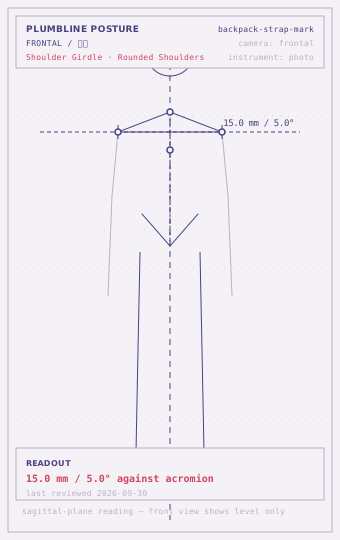
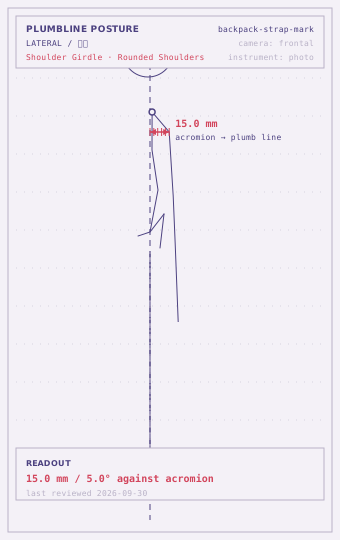
Within range
0-20 mmCriterion: The strap crosses within 20 mm of the acromion on both sides, lies flat without being pulled, and the shoulders stay level in the photograph.
The bag is being carried on the part of the shoulder built for load. Nothing to record beyond the date and the bag.
Borderline
21-40 mmCriterion: The strap crosses 21 to 40 mm medial to the acromion, or the shoulders are visibly uneven in the photograph, or the strap is adjusted during the two minutes.
The load is sitting on the neck side of the shoulder rather than on the bony point. Adjust the straps and re-photograph, then note whether the correction held.
Deviated
over 40 mmCriterion: The strap crosses more than 40 mm medial to the acromion, or the shoulder on the loaded side sits visibly lower, or the strap leaves a mark that is still there an hour later.
A mark that outlasts the carrying is the point at which the load has stopped being a carriage habit and started being a compression of the tissue under the strap.
| Tier | What to do |
|---|---|
| Low | Reading sits in the within-range band and is symmetric side to side: re-measure every 8–12 weeks and record which way the number is moving. |
| Moderate | Reading sits in the borderline band, or the two sides differ clearly: re-measure every 4–6 weeks and log the daily trigger (hours seated, one-sided load). Change the situation before adding anything to the routine. |
| High | Reading sits in the deviated band, or several screens at the same station all read deviated: get a clinician to rule out a structural or neural cause before continuing to self-screen. |
| Referral threshold | Numbness or tingling in the arm while the bag is worn, or a mark that stays for a day, needs the load changed and the symptoms assessed. |
Commonly co-occurring
How to read this
The load is part of the posture
Shoulder position screens measure the result. This one measures one of the most common causes, and it has the advantage of being cheap to change.
A strap that crosses the shoulder close to the neck loads the upper trapezius instead of the bony top of the shoulder, and the body responds by elevating the whole girdle to get out from under it. Wear that for a few hours a day and the shoulder spends a large fraction of its life in a position no exercise is going to argue with.
Procedure
Put the bag on the way you normally wear it. Sit down for a minute and stand up again — this is when straps settle into their real position rather than the position you set them to when you put the bag on. Then photograph the front and the back.
In the photographs, note two things: where the strap crosses relative to the acromion, and whether the two shoulders are at the same height. Then measure or estimate how far medial to the acromion the strap sits. Twenty millimetres is roughly the width of the bony point.
What to change
If the strap is medial to the acromion, the fix is in the strap: shorten it, tighten it, add a sternum strap, or move to a bag with two straps if the load is heavy. Re-photograph the same way after the change and compare the two sets.
If the shoulders are uneven, note which side is lower — it is almost always the loaded side. A difference that reverses when the bag moves to the other shoulder confirms the bag as the cause rather than the body.
A limit worth taking seriously
A strap mark that is still visible an hour after the bag comes off is not a cosmetic detail. Marks that persist mean pressure that has exceeded what the tissue under the strap can recover from quickly, and they often come with a dull ache down the arm. Change the load, and if the ache persists without the bag, have it assessed.
Questions
Isn't this just about the bag rather than the body?
It is about the interaction, and that is the point. The bag is the part you can change in an afternoon, and it is often the part producing the shoulder position the other screens at this station measure. Carry the same bag the same way for a month and no amount of scapular work will move the number.
Why photograph instead of just looking in the mirror?
Because a mirror lets you adjust as you look, and the adjustment is what the test is trying to catch. A photograph taken from behind by someone else, or by a phone propped up on a timer, records the position you were not watching.
Both straps on both shoulders or one?
Whatever you actually do. The test is not asking you to correct the habit for the measurement — it is asking what the habit is. Note which configuration was photographed so the record is not ambiguous later.
Disclaimer
This page is informational only. It is not a medical diagnosis and it is not treatment or rehabilitation advice. Run every self-screen inside a pain-free range; stop and see a clinician for pain, numbness, weakness, night pain, or anything that started after an injury. The readout criteria are drawn from healthy-adult norms — prior injury, surgery and individual variation all shift the numbers.
lastReviewed 2026-09-30 · record backpack-strap-mark · published 2026-10-09