- Home
- Pelvis
- Posterior Pelvic Tilt
- Chair Lumbar Profile
Chair Lumbar Profile
Measure the seat's front and back edges before measuring anything about the person sitting on it. A backward-sloping seat decides the pelvis's position before habit gets a vote.
- Gear
- A ruler or a phone with a level, and the chair you actually sit in.
- Stance
- Chair empty and on a level floor. Measure the height of the seat at the front edge and at the back edge, in the middle of the seat's width.
- Duration
- 180 s
- Camera angle
- lateral, lens level with the landmark
- Position
- Subtract the front height from the back height. A positive number means the seat rises toward the back; a negative number means it slopes backward.
Bone landmarks
-
L3 spinous process — coordinate id
lumbar -
Sacrum — coordinate id
sacrum -
PSIS — coordinate id
psis
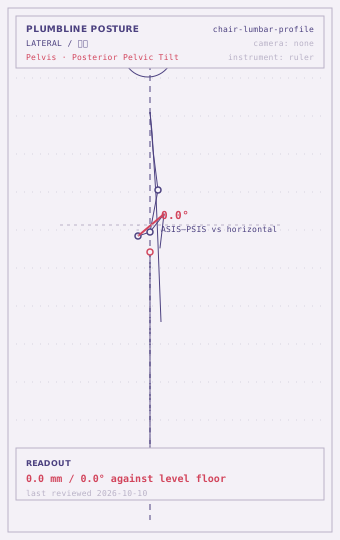
Within range
-10 to +10 mmCriterion: The seat surface is within 10 mm of level across its depth.
The seat neither forces the pelvis back nor pushes it forward. Most of the remaining variation in sitting position is habit and can be worked on.
Borderline
+10 to +25 mmCriterion: The seat rises 10 to 25 mm toward the back, which is the shape most task chairs are built with.
A mild rise is designed to keep the pelvis from sliding forward. It is acceptable if the person can still find tall sitting on it; check with the slump timer.
Deviated
under -10 or over +25 mmCriterion: The seat slopes backward by more than 10 mm, or rises by more than 25 mm across its depth.
A backward slope makes posterior tilt the path of least resistance all day. This is the single measurement most likely to explain a slump timer under three minutes.
| Tier | What to do |
|---|---|
| Low | Reading sits in the within-range band and is symmetric side to side: re-measure every 8–12 weeks and record which way the number is moving. |
| Moderate | Reading sits in the borderline band, or the two sides differ clearly: re-measure every 4–6 weeks and log the daily trigger (hours seated, one-sided load). Change the situation before adding anything to the routine. |
| High | Reading sits in the deviated band, or several screens at the same station all read deviated: get a clinician to rule out a structural or neural cause before continuing to self-screen. |
| Referral threshold | This is a measurement of furniture, not of a person. It needs no clinical referral whatever the number. |
Commonly co-occurring
How to read this
Measure the chair first
Most advice about sitting posture is advice about a person: sit up, take breaks, strengthen the back. All of it assumes the chair is neutral, and many chairs are not. A seat whose back edge sits 20 mm lower than its front edge puts the pelvis in posterior tilt the moment someone sits down, and holds it there for as long as they stay.
Under those conditions, sitting tall is a muscular effort against the furniture, and the slump timer will read two or three minutes no matter how motivated the person is.
Procedure
Put the chair on a level floor and measure the seat height at the front edge and at the back edge, at the middle of the seat’s width. Subtract the front figure from the back figure.
A positive result means the seat rises toward the back. A negative result means it slopes backward. Note which chair you measured and, if there is more than one, measure them all.
Reading it
Within 10 mm of level is neutral, and any posture work done on that chair has a fair chance. Ten to 25 mm of rise is the common commercial shape and is usually fine. A backward slope of more than 10 mm, or a rise beyond 25 mm, changes the pelvis’s default position enough to show up in the slump timer.
The measurement is not a verdict on the chair. It is a way of knowing which of two variables — the seat or the habit — is doing the work in a given case.
What to do about it
A backward-sloping seat can be shimmed at the back edge, replaced, or countered with a wedge cushion that does not slide. Any of those changes an input that applies to every seated hour, which is why this screen is worth running before any of the seated drills at this station.
Questions
Why measure the chair before the person?
Because the chair is the cheaper variable. If the seat slopes back 20 mm, correcting it changes the pelvis's resting position for every hour of every day, and no amount of posture practice does that. Measure the thing you can change first.
Is a backward-sloping seat always wrong?
No. Some seats slope back deliberately, and a mild slope is what most office chairs are built with. The problem is the combination of a steep slope and a person whose slump timer is short. Read the two together.
Where exactly do I measure?
At the middle of the seat's width, at the front edge and at the back edge, with the chair on a level floor. Measuring at the sides reads the chair's contour rather than its slope, which is a different number.
Disclaimer
This page is informational only. It is not a medical diagnosis and it is not treatment or rehabilitation advice. Run every self-screen inside a pain-free range; stop and see a clinician for pain, numbness, weakness, night pain, or anything that started after an injury. The readout criteria are drawn from healthy-adult norms — prior injury, surgery and individual variation all shift the numbers.
lastReviewed 2026-10-10 · record chair-lumbar-profile · published 2026-10-20