- Home
- Shoulder Girdle
- Rounded Shoulders
- Prone Lift-Off Hold Time
Prone Lift-Off Hold Time
Face down, lift both shoulder blades, and time how long they stay up before the neck takes over. A capacity reading, not a position reading.
- Gear
- A firm flat surface, a small pillow for the forehead, and a timer.
- Stance
- Lie face down, forehead on the pillow, arms at the sides with the palms up, shoulders relaxed.
- Duration
- 90 s
- Camera angle
- frontal, lens level with the landmark
- Position
- Lift both shoulder blades gently toward the ceiling without arching the lower back or lifting the head, and hold. Time until the blades drop or the neck takes over.
Bone landmarks
-
Scapular spine — coordinate id
scapular-spine -
Acromion — coordinate id
acromion -
C7 spinous process — coordinate id
c7
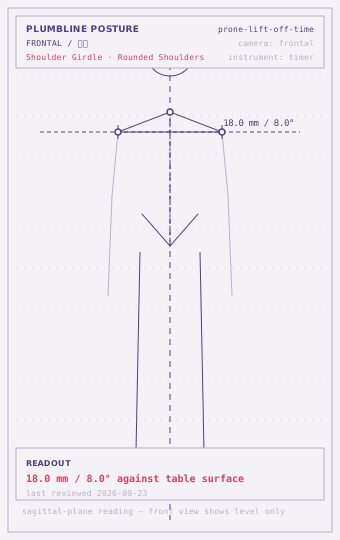
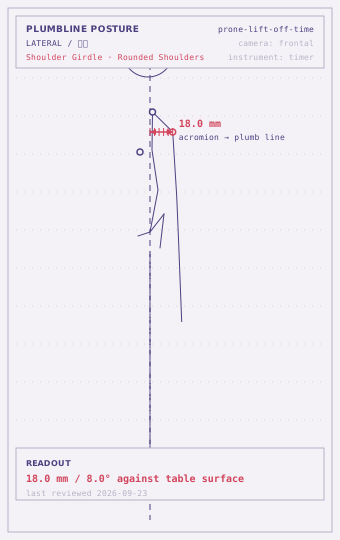
Within range
over 15 sCriterion: Both blades stay lifted for more than 15 seconds with the neck relaxed and no arching of the lower back.
The scapular retractors can hold the girdle against gravity. Re-check when the working position changes.
Borderline
6-15 sCriterion: Between 6 and 15 seconds, or the lift succeeds on one side only, or the neck extensors visibly take over before the timer stops.
The hold fails by substitution. Note the side and re-measure four weeks after altering the daily setup, not after adding practice.
Deviated
under 6 sCriterion: Under 6 seconds, or the head lifts and the neck does the work, or lifting the blades produces pain at the front of the shoulder.
Pain on this movement ends the screen. Anterior shoulder pain during scapular retraction is not a capacity finding.
| Tier | What to do |
|---|---|
| Low | Reading sits in the within-range band and is symmetric side to side: re-measure every 8–12 weeks and record which way the number is moving. |
| Moderate | Reading sits in the borderline band, or the two sides differ clearly: re-measure every 4–6 weeks and log the daily trigger (hours seated, one-sided load). Change the situation before adding anything to the routine. |
| High | Reading sits in the deviated band, or several screens at the same station all read deviated: get a clinician to rule out a structural or neural cause before continuing to self-screen. |
| Referral threshold | Pain at the front of the shoulder when the blades are lifted, or a shoulder that clicks or catches with each repetition, should be assessed. |
Commonly co-occurring
How to read this
Capacity, measured face down
The shoulder girdle has two jobs and this screen tests the second one. The first is to let the arm move; the second is to hold the position of the blade against gravity while the arm does something else. A forward carriage is usually described as a position, but it is just as often a capacity problem: the muscles that would hold the blade back are not being used, so the blade drifts.
Testing that face down removes the arm from the equation. You are not asked to hold a weight, only to hold a position, and the timer records how long the position survives.
Procedure
Lie face down with a small pillow under the forehead so the neck is not twisted, arms relaxed at the sides, palms up. Draw both shoulder blades gently toward the spine and slightly toward the ceiling — a small movement, not a squeeze.
Start the clock. Breathe normally and watch three things: whether the head starts to press into the pillow, whether the lower back arches, and whether the blades slowly drop. Stop at the first of those that happens.
Reading it
Fifteen seconds or more with the neck quiet is a working hold. Between six and fifteen seconds, or a hold where the neck visibly joins in, is the substitution pattern: the position is achieved but not held by the muscles meant to hold it.
Under six seconds, or a hold accompanied by pain at the front of the shoulder, is the point to stop. Pain during scapular retraction usually means the shoulder is being asked to move through a range it does not have, which is a different problem from a capacity one.
Using the number
This is a capacity reading, so it changes with use — but only slowly, and only if the daily position stops fighting it. Record it, change the desk, and re-measure in four weeks. A number that improves while the wall contact screen stays the same tells you the muscle got better and the posture did not, which is useful to know and easy to miss if only one screen is being tracked.
Questions
Should my head stay down?
Yes. Lifting the head brings the neck extensors in and makes the hold easier by cheating, which is exactly the substitution the test is meant to detect. Keep the forehead on the pillow and watch for the moment the head starts to press down into it.
Why prone rather than against a wall?
Because lying face down takes the weight of the arms out of the equation. Standing versions are dominated by how the arms are held, which makes the reading depend on the shoulder's elevation range rather than on the retractors' capacity.
How long should a normal hold be?
Fifteen seconds is a reasonable working boundary for this position; well-trained people hold much longer, and people with a long-standing forward carriage often cannot reach ten. What matters is your own number moving, not the boundary itself.
Disclaimer
This page is informational only. It is not a medical diagnosis and it is not treatment or rehabilitation advice. Run every self-screen inside a pain-free range; stop and see a clinician for pain, numbness, weakness, night pain, or anything that started after an injury. The readout criteria are drawn from healthy-adult norms — prior injury, surgery and individual variation all shift the numbers.
lastReviewed 2026-09-23 · record prone-lift-off-time · published 2026-10-02