- Home
- Shoulder Girdle
- Rounded Shoulders
- Supine Shoulder-to-Floor Gap
Supine Shoulder-to-Floor Gap
Lie flat and measure the space under each shoulder. Gravity does the work, so the reading shows where the shoulder rests when nothing is holding it.
- Gear
- A firm flat surface and a ruler.
- Stance
- Lie on the back with the knees bent, arms at the sides, palms down, letting the shoulders rest where they fall.
- Duration
- 60 s
- Camera angle
- lateral, lens level with the landmark
- Position
- Measure the gap between the back of each acromion and the surface. Then draw the shoulders gently back and measure again.
Bone landmarks
-
Left acromion — coordinate id
acromion-l -
Right acromion — coordinate id
acromion-r -
C7 spinous process — coordinate id
c7 -
Sternal notch — coordinate id
sternum
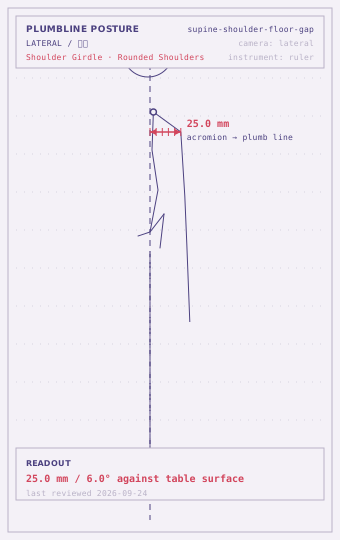
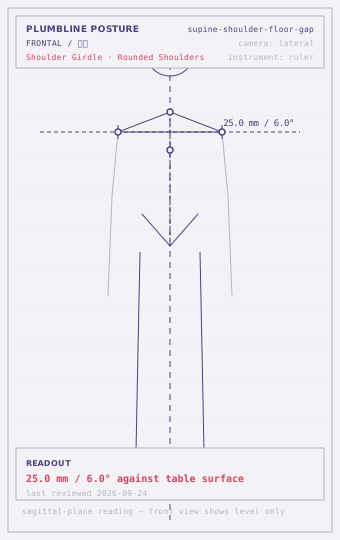
Within range
0-12 mmCriterion: Both acromions rest within 12 mm of the surface with the arms relaxed, and the cued gap is under 5 mm.
Gravity alone brings the shoulders back to the surface. The girdle's resting position is close to the rib cage.
Borderline
13-30 mmCriterion: A gap of 13 to 30 mm on one or both sides that closes by more than half when the shoulders are drawn back.
The shoulders need an effort to reach the surface. Log it and change one thing about the desk before re-measuring in four weeks.
Deviated
over 30 mmCriterion: More than 30 mm on one side, or a gap that barely closes on cue, or the two sides differ by more than 20 mm.
A large one-sided gap that will not close is usually a fixed change in the shoulder itself rather than a carriage habit. Screen elevation and rotation range before reading it as posture.
| Tier | What to do |
|---|---|
| Low | Reading sits in the within-range band and is symmetric side to side: re-measure every 8–12 weeks and record which way the number is moving. |
| Moderate | Reading sits in the borderline band, or the two sides differ clearly: re-measure every 4–6 weeks and log the daily trigger (hours seated, one-sided load). Change the situation before adding anything to the routine. |
| High | Reading sits in the deviated band, or several screens at the same station all read deviated: get a clinician to rule out a structural or neural cause before continuing to self-screen. |
| Referral threshold | A shoulder that cannot be brought back at all, or that produces arm pain when it is, needs assessment rather than more self-screening. |
Commonly co-occurring
How to read this
Letting gravity answer
Standing screens require the person to hold a position, and how hard they try is part of the measurement. Lying down removes that variable almost completely. The shoulder drops until something stops it, and the distance it stops at is the reading.
That makes this the best screen at the station for a first measurement, and a good one to repeat after any change, because it is the least sensitive to effort and motivation.
Procedure
Lie on a firm flat surface, knees bent so the lower back is comfortable, arms at the sides with the palms down. Let everything settle for thirty seconds without adjusting anything.
Measure from the surface up to the back of each acromion — the same bony point used in the standing screens, found by touch. Then draw the shoulders gently down and back and measure again. Record four numbers: two resting, two cued.
Reading the four numbers
The resting pair tells you where the shoulders sit. The cued pair tells you whether that position is something the body can leave. A resting gap of 22 mm that drops to 3 mm when corrected is a carriage habit; the same 22 mm that drops only to 18 mm is a shoulder that has adapted, and no amount of cueing will move it.
The side-to-side difference is the third reading. Most people have some; a new difference, or one over about 20 mm, is worth writing down with a date beside it.
What to do with it
A gap that closes on cue points at the day’s setup, not at the shoulder. Move the keyboard, lower the armrests, change which shoulder carries the bag, and re-measure in four weeks. A gap that does not close has left the range this screen can read, and the next step is an assessment rather than another measurement.
Questions
Does a firm surface really matter this much?
It does, and this is the most common way the measurement goes wrong. On a soft mattress the shoulders sink, and the gap you measure is the mattress compressing under one point rather than the shoulder's position. Use a floor or a firm table.
Arms at the sides or out?
At the sides, palms down. Arms out to the sides rotates the scapula and pulls the acromion closer to the surface, which flatters the reading by ten millimetres or more.
Why measure after drawing the shoulders back as well?
Because the resting gap alone cannot tell a shoulder that is forward from a shoulder that is stuck forward. If the gap closes on cue, the position is available and the daily setting is the thing to change. If it does not close, the limit is structural and self-measurement has reached its edge.
Disclaimer
This page is informational only. It is not a medical diagnosis and it is not treatment or rehabilitation advice. Run every self-screen inside a pain-free range; stop and see a clinician for pain, numbness, weakness, night pain, or anything that started after an injury. The readout criteria are drawn from healthy-adult norms — prior injury, surgery and individual variation all shift the numbers.
lastReviewed 2026-09-24 · record supine-shoulder-floor-gap · published 2026-09-30