- Home
- Head and Neck
- Forward Head
- Side Photo Tragus Angle
Side Photo Tragus Angle
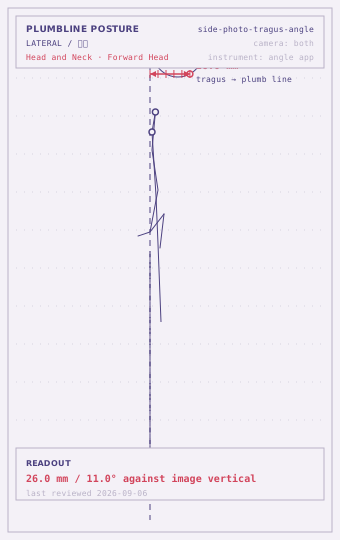
A lateral photograph with two marks on it: the tragus and the C7 spine. The angle of that line away from vertical is the reading, and the cued photo shows whether it is reversible.
- Gear
- A phone on a tripod or a stack of books, a plain wall behind you, and a free angle-measuring app or a printed protractor.
- Stance
- Stand side-on to the camera, arms relaxed, gaze level, feet in your usual stance. Wear a fitted top so the shoulder and the ear are not hidden.
- Duration
- 90 s
- Camera angle
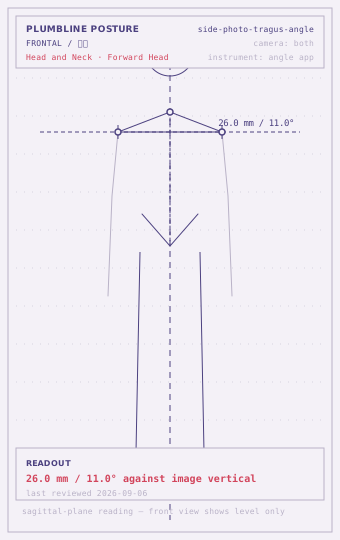
- one frontal and one lateral frame
- Position
- Camera at shoulder height, 2.5 to 3 m away, square to the body. Mark the tragus and the C7 spine on the photo, then measure the angle between that line and the vertical.
Bone landmarks
-
Tragus — coordinate id
tragus -
C7 spinous process — coordinate id
c7 -
Acromion — coordinate id
acromion
Within range
0-8 °Criterion: The tragus-to-C7 line sits within 8 degrees of vertical in the standing photo.
The head is stacked close enough to plumb that no single correction is indicated. Re-photograph in three months using the same camera distance.
Borderline
9-16 °Criterion: The line sits 9 to 16 degrees off vertical, and the angle closes by at least 4 degrees when the subject retracts the chin.
A real but reversible angle. Photograph again four weeks after changing the screen height, and compare the two images rather than the two angles alone.
Deviated
over 16 °Criterion: More than 16 degrees off vertical, or the angle barely changes when the subject retracts the chin, or the shoulder itself sits well forward of the hip line.
At this angle the head position is usually part of a longer forward chain. Measure the thoracic and pelvic position in the same photo before treating the neck as the source.
| Tier | What to do |
|---|---|
| Low | Reading sits in the within-range band and is symmetric side to side: re-measure every 8–12 weeks and record which way the number is moving. |
| Moderate | Reading sits in the borderline band, or the two sides differ clearly: re-measure every 4–6 weeks and log the daily trigger (hours seated, one-sided load). Change the situation before adding anything to the routine. |
| High | Reading sits in the deviated band, or several screens at the same station all read deviated: get a clinician to rule out a structural or neural cause before continuing to self-screen. |
| Referral threshold | A photograph is not a diagnosis. If the neck has lost rotation or side-bend range, or if there is any arm symptom, the next step is an assessment, not another photo. |
Commonly co-occurring
How to read this
Angle, not distance
The wall test gives a distance in millimetres, and that number depends on where you stand and how tall you are. An angle does not. That is the whole reason to take the photograph: the angle between the tragus-to-C7 line and the vertical is comparable between two people, and, more usefully, comparable between two dates for the same person.
The cost is that a photograph introduces its own errors. Camera height, camera tilt, camera distance and where you crop all change the measured angle, and none of them are visible in the number you write down. Control them explicitly and write them down beside the angle.
Setting up
Stand side-on with the shoulder nearest the camera relaxed and unobstructed. A loose top hides the acromion and a high collar hides C7, so wear something fitted and keep the hair clear of the neck. Camera at shoulder height, 2.5 to 3 m back, level — check against the app’s grid rather than by eye.
Mark the tragus and the C7 spinous process. C7 is found by dropping the chin and feeling for the vertebra that stays most prominent as the head moves; it is the one that does not slide away. Draw the line between the two points and measure its angle from the image vertical.
Then take a second frame with the chin gently retracted, and measure the same angle. The pair — resting and cued — is the record.
Reading the two angles
The resting angle is what you track over months. It is the number that answers “has this changed since last time”.
The cued angle is what you use once. It answers “is there anything here to change”. A resting angle of 14 degrees that drops to 5 on cue means the neck can hold the head over the shoulders and simply is not doing so by default. A resting angle of 14 that drops to 12 means the head position is not the first problem to look at.
The difference between them is more informative than either alone, and it is the reason a single photograph is not enough to make this test mean anything.
What it cannot show
A lateral photograph flattens three dimensions. It cannot show rotation, it cannot show side-bend, and it cannot distinguish a head that is forward because of the upper neck from one that is forward because the whole thoracic spine has moved back. If the shoulder in the same photograph is well forward of the hip, the head angle is a symptom of that, not the finding.
Questions
How far away should the camera be?
2.5 to 3 m at shoulder height, square to the body. Closer and perspective distortion tilts the apparent verticals at the edges of the frame; further and the landmarks become too small to mark accurately. Keep the distance identical between the baseline and the follow-up photo, or the two angles are not comparable.
Does camera tilt matter?
Enormously. A phone that is 3 degrees off level adds 3 degrees to every angle measured off the image vertical. Level it against a door frame or use the app's grid overlay, and check the vertical of a wall corner in the frame before you start marking points.
Which reading do I compare later?
The resting one. The cued angle tells you whether the position is correctable; the resting angle is the one that tracks change over months, so it is the one to keep photographing.
Disclaimer
This page is informational only. It is not a medical diagnosis and it is not treatment or rehabilitation advice. Run every self-screen inside a pain-free range; stop and see a clinician for pain, numbness, weakness, night pain, or anything that started after an injury. The readout criteria are drawn from healthy-adult norms — prior injury, surgery and individual variation all shift the numbers.
lastReviewed 2026-09-06 · record side-photo-tragus-angle · published 2026-09-14