- Home
- Pelvis
- Posterior Pelvic Tilt
- Sitting Bone Pressure Shift
Sitting Bone Pressure Shift
Hands under the buttocks on a hard chair. Where the weight actually lands, and whether it is the same on both sides, is something no photograph shows.
- Gear
- A hard chair and both hands, used to feel rather than to see.
- Stance
- Sit upright on a hard chair with the feet flat, hands slipped under the buttocks, palms up.
- Duration
- 180 s
- Camera angle
- lateral, lens level with the landmark
- Position
- Compare the pressure under each sitting bone, then lean slowly forward and back and feel how the pressure moves. Note whether one side is consistently heavier.
Bone landmarks
-
PSIS — coordinate id
psis -
Sacrum — coordinate id
sacrum -
Greater trochanter — coordinate id
greater-trochanter
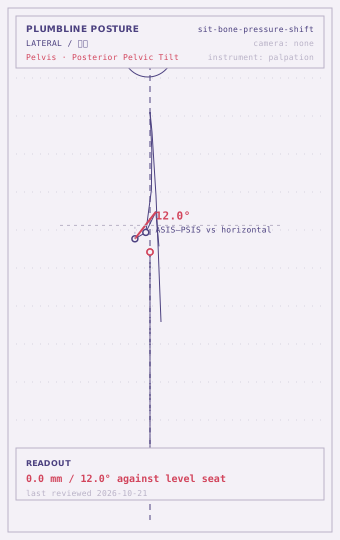
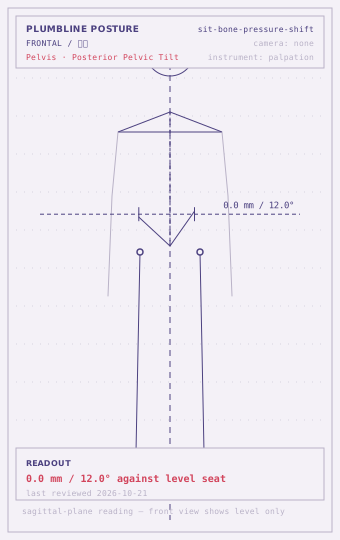
Within range
3 gradeCriterion: Both sitting bones are felt evenly, and leaning forward shifts the pressure toward the front of the pelvis while leaning back shifts it toward the sacrum, smoothly in both directions.
The seat is bearing the pelvis evenly and the pelvis is free to move on it. Re-check after any change of chair.
Borderline
2 gradeCriterion: One sitting bone is clearly heavier, or the pressure shift on leaning is abrupt, or the sitting bones cannot be felt at all because the soft tissue is taking the load.
An uneven load is worth pairing with a side-on photo, since a pelvis that is level in the front view can still be rotated in the other two planes.
Deviated
0-1 gradeCriterion: The sitting bones cannot be found on either side, or sitting is painful, or the pressure is entirely under the thighs rather than the pelvis.
Pain on sitting, or weight borne by the thighs, is a seating problem with a clinical edge. Address the seat and, if the pain persists, seek an assessment.
| Tier | What to do |
|---|---|
| Low | Reading sits in the within-range band and is symmetric side to side: re-measure every 8–12 weeks and record which way the number is moving. |
| Moderate | Reading sits in the borderline band, or the two sides differ clearly: re-measure every 4–6 weeks and log the daily trigger (hours seated, one-sided load). Change the situation before adding anything to the routine. |
| High | Reading sits in the deviated band, or several screens at the same station all read deviated: get a clinician to rule out a structural or neural cause before continuing to self-screen. |
| Referral threshold | Sitting pain that persists despite a change of seat, or that comes with numbness in the saddle area, needs assessment. |
Commonly co-occurring
How to read this
The reading with no picture
Everything else at this station can be photographed. This one cannot, because the load is inside the contact between the pelvis and the seat, where no camera reaches. Hands under the buttocks on a hard chair are the practical way to get at it, and the information they give is not available any other way.
Procedure
Sit upright on a hard chair, feet flat on the floor, and slip both hands under the buttocks with the palms up. Find the two sitting bones. Compare the pressure under each.
Then lean slowly forward until the pressure moves to the front of the pelvis, and back until it moves toward the sacrum. Note whether both directions are smooth or whether one is abrupt.
Reading it
Even pressure and a smooth transfer in both directions is the reference. One side clearly heavier, an abrupt transfer, or sitting bones that cannot be located because the soft tissue is taking everything, are all worth recording.
The uneven load is the most useful of the three, because it is the one that pairs with a photograph. Take the side-on frame from the pelvis photo screen and read the two together.
Why this one is worth repeating
Because it is the screen most sensitive to the small habits nobody counts: the wallet in the pocket, the leg that is always crossed the same way, the ankle hooked round the chair leg. Those are trivial to change and each of them applies for hours at a time, which is why finding one is usually worth more than any exercise added to the day.
Questions
Why a hard chair?
Because a soft cushion spreads the load over the whole contact area and makes the reading useless. On a hard seat the two sitting bones are the only high points, so a difference between them is a difference in the pelvis rather than in the foam.
Which sitting bones am I feeling for?
The lowest points of the pelvis, one under each buttock, roughly a hand's width apart. If you cannot tell them from the surrounding tissue, say so — that finding is the reading, not a failure to perform the test.
Is one side being heavier always a problem?
No. Most people have a dominant side and a small difference is ordinary. What is worth following is a difference that is new, or one that changes the way the person sits rather than the other way around.
Disclaimer
This page is informational only. It is not a medical diagnosis and it is not treatment or rehabilitation advice. Run every self-screen inside a pain-free range; stop and see a clinician for pain, numbness, weakness, night pain, or anything that started after an injury. The readout criteria are drawn from healthy-adult norms — prior injury, surgery and individual variation all shift the numbers.
lastReviewed 2026-10-21 · record sit-bone-pressure-shift · published 2026-10-24