- Home
- Pelvis
- Posterior Pelvic Tilt
- Sit-to-Stand Spine Roll
Sit-to-Stand Spine Roll
Film three rises from the side. The order in which the pelvis, the spine and the knees move separates a hip problem from a back one, and it is invisible from the front.
- Gear
- A chair without arms, and a phone filming from the side at hip height.
- Stance
- Sit on the front half of the chair, feet flat, arms folded across the chest. Film the whole movement from the side.
- Duration
- 120 s
- Camera angle
- lateral, lens level with the landmark
- Position
- Stand up at your normal speed, then sit back down, three times. Watch the film for the sequence in which the pelvis, the spine and the knees move.
Bone landmarks
-
L3 spinous process — coordinate id
lumbar -
Sacrum — coordinate id
sacrum -
C7 spinous process — coordinate id
c7 -
Greater trochanter — coordinate id
greater-trochanter
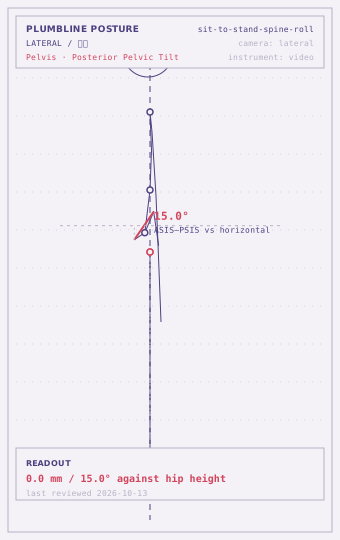
Within range
3 phaseCriterion: The pelvis tilts forward first, the spine follows as a series of small increments, and the knees bend in time with the hips. Three separate phases are visible.
The hips are contributing their share of the movement. Re-check only if the person's back pain changes.
Borderline
2 phaseCriterion: Two phases are visible, or the pelvis tilts forward only after the spine has already begun to flex, or the movement is visibly slower than the person's normal speed.
The hip is under-contributing and the spine is covering for it. This is the most common pattern in people whose lower back aches after long sitting.
Deviated
0-1 phaseCriterion: The spine flexes as one block before the hips move at all, or standing requires a hand push, a forward lurch, or several attempts.
A rise that needs the arms or a lurch is a transfer strategy, not a posture habit. Have the hip and the knee measured before training the pattern.
| Tier | What to do |
|---|---|
| Low | Reading sits in the within-range band and is symmetric side to side: re-measure every 8–12 weeks and record which way the number is moving. |
| Moderate | Reading sits in the borderline band, or the two sides differ clearly: re-measure every 4–6 weeks and log the daily trigger (hours seated, one-sided load). Change the situation before adding anything to the routine. |
| High | Reading sits in the deviated band, or several screens at the same station all read deviated: get a clinician to rule out a structural or neural cause before continuing to self-screen. |
| Referral threshold | An inability to rise without a hand push, or pain in the hip or groin during rising, should be assessed before it is trained. |
Commonly co-occurring
How to read this
Order of events
Standing up is a movement with a correct order: the pelvis tilts forward, the hips extend, the spine follows, the knees straighten. When one part of that order is missing, the parts around it take over — and which part takes over is what determines where it hurts.
The person whose spine flexes because the hips will not extend gets back pain after every rise. The person whose knees do the work gets knee pain. Neither is visible from the front, and neither shows up in a still photograph.
Procedure
Sit on the front half of a chair without arms, feet flat, arms folded across the chest. Film from the side at roughly hip height. Stand up and sit down three times at a normal speed.
Watch the film, slowing it down if needed, and mark the order: when the pelvis tilts forward, when the spine begins to flex, when the knees start to bend.
Reading it
Three distinct phases, in the right order, at normal speed, is the reference. Two phases, or a spine that flexes before the pelvis moves, means the hip is under-contributing and the spine is covering for it.
A rise that needs a forward lurch, a hand push or several attempts is a different category entirely. That is a transfer strategy, and it means the hip and the knee need measuring before any pattern work is worth doing.
Repeating it
Film the same three rises at the same camera height every few weeks. The change that matters is not smoothness — it is whether the order changes. A spine that stops flexing first is progress that a person can see, which makes this one of the more motivating screens at the station.
Questions
Why folded arms?
Because a hand push on the thighs changes the movement completely and hides the thing you are looking at. Fold the arms and rise from a chair without arms so there is nothing to push against.
How fast should I stand?
At your normal speed, which is the whole point — a deliberately slow or careful rise is a different movement. If you need to slow down to do it correctly, that is itself part of the finding.
What if I cannot see the phases on film?
Slow the video down. Most phones will scrub frame by frame. The sequence is usually visible within a third of a second, which is far faster than the eye separates live.
Disclaimer
This page is informational only. It is not a medical diagnosis and it is not treatment or rehabilitation advice. Run every self-screen inside a pain-free range; stop and see a clinician for pain, numbness, weakness, night pain, or anything that started after an injury. The readout criteria are drawn from healthy-adult norms — prior injury, surgery and individual variation all shift the numbers.
lastReviewed 2026-10-13 · record sit-to-stand-spine-roll · published 2026-10-22