- Home
- Pelvis
- Anterior Pelvic Tilt
- Supine Flat-Back Hold Time
Supine Flat-Back Hold Time
Flatten the lower back on the floor and time how long it stays flat. It tests holding capacity rather than range, and the way the hold fails is the useful part.
- Gear
- A firm flat surface and a timer.
- Stance
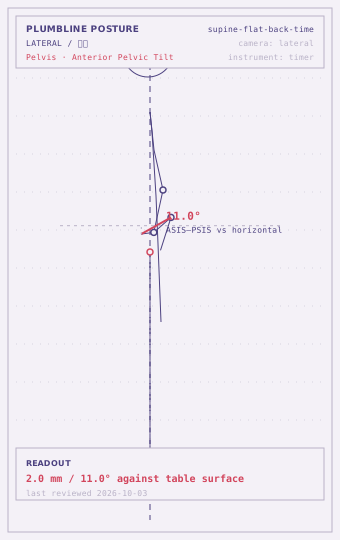
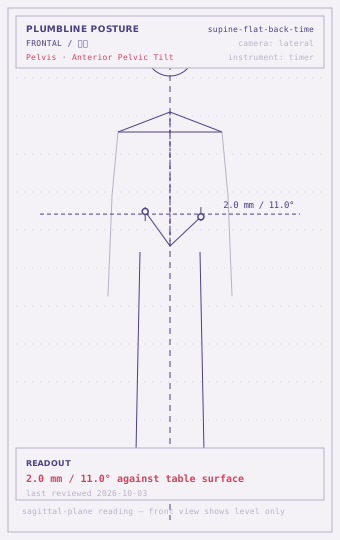
- Lie on the back with the knees bent over a pillow, arms at the sides, lower back in its natural position.
- Duration
- 180 s
- Camera angle
- lateral, lens level with the landmark
- Position
- Flatten the lower back lightly against the surface and hold it there while breathing normally. Time how long it stays flat before the curve returns.
Bone landmarks
-
ASIS — coordinate id
asis -
L3 spinous process — coordinate id
lumbar -
Sacrum — coordinate id
sacrum
Within range
over 60 sCriterion: The flattened position holds for more than 60 seconds with normal breathing and no bracing.
The pelvis can hold neutral without continuous conscious effort. Re-check when the working position changes.
Borderline
20-60 sCriterion: Between 20 and 60 seconds, or the position holds only while the breath is held or the abdomen is braced hard.
The position is available but needs supervision. This is the band where changing the chair moves the number, and adding exercises does not.
Deviated
under 20 sCriterion: Under 20 seconds, or the lower back cannot be brought flat at all without lifting the pelvis off the surface, or holding it produces pain.
If flattening the back requires lifting the pelvis, the tilt is being driven from the hip rather than held by habit. The heel slide screen at this station is the one to run next.
| Tier | What to do |
|---|---|
| Low | Reading sits in the within-range band and is symmetric side to side: re-measure every 8–12 weeks and record which way the number is moving. |
| Moderate | Reading sits in the borderline band, or the two sides differ clearly: re-measure every 4–6 weeks and log the daily trigger (hours seated, one-sided load). Change the situation before adding anything to the routine. |
| High | Reading sits in the deviated band, or several screens at the same station all read deviated: get a clinician to rule out a structural or neural cause before continuing to self-screen. |
| Referral threshold | Pain while holding the back flat, or a lower back that cannot be flattened at all, should be assessed rather than trained. |
Commonly co-occurring
How to read this
How long the pelvis can hold neutral
Range says whether a position is available. Hold time says whether it is sustainable. For the pelvis, the gap between those two is large: almost everyone with an anterior tilt can flatten the lower back on the floor, and a good number of them can only do it for twenty seconds.
This screen measures the second number. It is deliberately undramatic and it is one of the most useful readings at this station, because it responds to things — chairs, chairs with reclined seats, standing desks set too high — that are cheap to change.
Procedure
Lie on your back with a pillow under the knees and the arms at the sides. Draw the pelvis gently toward the ribs until the lower back contacts the surface without being pressed. Start the clock.
Breathe normally and watch for the moment the curve returns. Stop when it does, or when the breath has to be held to keep the position, or when the abdomen is being braced hard. Repeat twice and take the better attempt.
Reading it
Over a minute with quiet breathing means the pelvis holds neutral on its own. Between twenty and sixty seconds means it can be held but not maintained, and the fix is a change in the chair or the standing position rather than more practice. Under twenty seconds usually means something else is driving the tilt — most often a hip that will not extend — and the heel slide screen is the next measurement to take.
Why the failure mode matters again
As with the neck holding screens, the number is less informative than how the hold ends. A hold that fades because the muscles used up their capacity is a strength reading. A hold where the pelvis simply rolls forward while the person believes nothing has changed is a position reading, and it is the second pattern that points back at the chair.
Questions
Pillow under the knees or not?
Yes, under the knees. It takes the hamstrings out of the equation, and hamstrings pulling on the pelvis is the most common reason the back cannot be flattened by a person who otherwise can.
How hard should I press?
Lightly — just until the curve contacts the surface. Pressing hard turns this into an abdominal strength test and produces hold times that have nothing to do with the pelvis's resting position.
Should I keep breathing normally?
Yes, and this is the whole difficulty of the test. Many people hold the position with a breath hold, which works for ten or fifteen seconds and then fails. The timing is only meaningful if the breathing is unchanged.
Disclaimer
This page is informational only. It is not a medical diagnosis and it is not treatment or rehabilitation advice. Run every self-screen inside a pain-free range; stop and see a clinician for pain, numbness, weakness, night pain, or anything that started after an injury. The readout criteria are drawn from healthy-adult norms — prior injury, surgery and individual variation all shift the numbers.
lastReviewed 2026-10-03 · record supine-flat-back-time · published 2026-10-13